If you need a Transport Manager CPC, the hardest part is often not the exam itself – it is choosing how to study for it. Whether you choose the Transport Manager CPC Classroom option, a 10-day intensive classroom course, or a home study route you fit around work, and hybrid options that mix the two, the “best” choice depends almost entirely on your week, your budget and how you learn.
This guide compares the three main routes to a transport management CPC in plain English, so you can pick the one that gets you qualified fastest without wasting time or money. It covers time commitment, cost, exam format and the support you actually get along the way – and where Open Road Training’s accredited, instructor-led delivery makes a difference.
What the Transport Manager CPC actually involves
The Transport Manager CPC is the qualification that lets you act as a named transport manager on an operator licence – road haulage, passenger transport, or both. It is not just a certificate of attendance. You sit external exams, and a pass is what the Traffic Commissioner looks for when you apply for or vary an operator licence.
Two exam units matter:
- A multiple-choice paper covering the legal, financial and operational framework you manage day to day.
- A case study paper where you apply that knowledge to a real-world operator scenario – costings, compliance, planning and problem-solving.
The qualification is the same whichever route you take. What changes is how you get there.
Route 1: The 10-day intensive classroom course
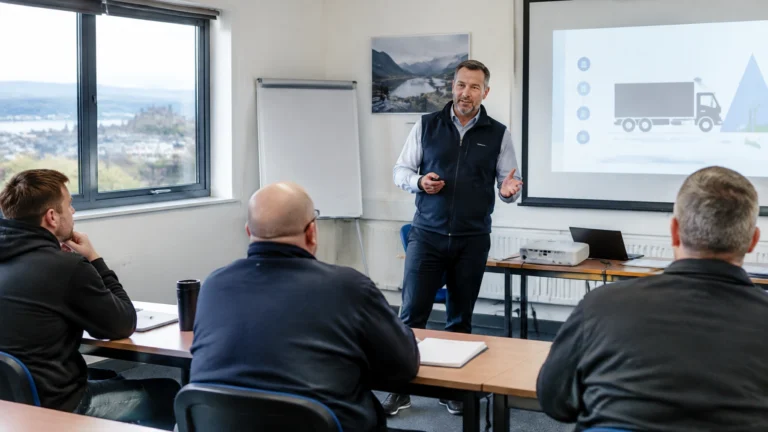
This is the traditional, full-speed option: 10 days of instructor-led tuition over a 3-week period, in a room, with a cohort doing the same thing.
Best for: people who want it done and dusted quickly, learn well in a group, and can take roughly two weeks away from the day job.
What you get with Open Road Training’s Transport Manager CPC course:
- Ten days of expert tuition from trainers who work in the industry, not just teach it
- Printed study materials you keep
- Full eLearning access for revision between sessions
- A one-year TM App subscription so you can keep checking yourself on the move
- £1500 including VAT – one clear price, no extras to bolt on
The advantages are momentum and accountability. You cover the syllabus in a tight block, ask questions the moment something doesn’t click, and keep your examiner-facing knowledge fresh because the exam is close to the classroom. The trade-off is the diary: ten working days out of the business, whether you are the transport manager or the person covering for one.
Route 2: Transport Manager CPC Home Study
Home study flips the model: same qualification, your own timetable, no classroom to attend.
Best for: working transport professionals who cannot step away for two weeks, or learners who prefer to read, revise and test themselves at their own pace.
The Transport Manager CPC Home Study route gives you:
- A remote road haulage or passenger transport qualification – choose the one that matches your licence type
- Up to six months of eLearning access, so you can work through the units around shifts
- Printed manuals for the paper-and-pen learners
- Online exams, so you do not have to travel to sit them
- Flexible payment options
The advantage is flexibility, and the honest trade-off is discipline. No tutor is looking over your shoulder on a Tuesday night, so the people who do best set a fixed study slot and stick to it. If you like the structure of a room and a deadline, home study can feel slow – which is exactly why the upgrade option exists.
Route 3: Hybrid – home study with classroom upgrades
The middle path is the one a lot of operators end up choosing once they have started. You enrol on home study, then add classroom days for the sections you find hardest – often the case study and costings work.
Best for: anyone who wants the pace of home study but knows they will need expert help on specific topics, or who wants to break the cost across a longer period before committing to a full intensive block.
It is not a lesser route. It is the same qualification, approached with more control over when and how you spend your time. If your compliance calendar is tight and you want the fastest realistic date, price the intensive first. If the diary will not flex, take home study and plan your upgrade days early rather than at the last minute.
How to choose: four questions that settle it
- How much time can you genuinely take off? Three clear weeks point to the intensive. Scattered evenings and a few hours at weekends point to home study.
- How do you learn best? Group tuition with immediate answers suits classroom. Reading, revising and self-testing suit home study.
- What is your deadline? If you need to be named on a licence application soon, work backwards from the exam dates and let that decide.
- Which licence type are you covering? Road haulage and passenger transport have different content – make sure the route you book matches the licence you actually hold or need.
Whatever you choose, the qualification, exams, and standard you need to meet are the same. The right route is the one you will actually finish.
The one thing that should not vary
Accreditation and trainer quality should be identical across all three routes – and that is where Open Road Training draws the line. We aren’t just trainers; we’re industry professionals: people who have worked in transport and know what the Traffic Commissioner and DVSA expect, explaining the syllabus in plain English without the jargon.
That matters most when the case study paper gets hard, because the difference between a pass and a resit is usually someone who can show you how the theory lands in a real operator’s week.
Next step
If you are ready to book, start with the route that matches your diary: the ten-day intensive Transport Manager CPC if you want it finished fast, or home study with classroom upgrades if flexibility matters more.
Get qualified. Stay compliant.