Most operators think ADR 2027 is a future problem.
It is not.
The new requirements take effect on 1 January 2027. These regulations specifically address Lithium Batteries : ADR and affect loads you may already carry, including ene
rgy storage systems, containers with their own power supply, returned electronics and batteries moving to repair or recycling.
The headline change is simple to explain. The practical consequences need more care.
A single entry, UN 3536, is being split into three entries for batteries installed in a cargo transport unit. In other words, UN 3536 has had a paperwork divorce. You now need to know which battery chemistry is involved before you prepare the transport documents, markings and instructions.
This guide explains what the change means for haulage operators, consignors and ADR drivers. It also explains why reviewing your ADR training and ADR course plans now is sensible.
1. What is changing on 1 January 2027?
1.1 Does every lithium battery get a new UN number?
No.
The change specifically concerns batteries installed in a cargo transport unit. Examples include:
- Containers housing energy storage systems.
- Bodies with their own integrated power supply.
- Cargo transport units containing installed battery systems.
Loose batteries, batteries packed with equipment and batteries contained in equipment remain subject to their relevant existing entries.
The three new entries are:
| UN number | Proper description |
|---|---|
| UN 3536 | Lithium-ion batteries installed in a cargo transport unit |
| UN 3563 | Lithium-metal batteries installed in a cargo transport unit |
| UN 3564 | Sodium-ion batteries installed in a cargo transport unit |
This means you must review the chemistry of the battery installed in the cargo transport unit. You must then update the UN number, transport description and related records.
1.2 Why does this matter to you?
If you are a consignor, you may be responsible for classifying the load and preparing the transport documentation.
If you are a carrier, you need to know whether the information supplied to you is complete and whether your vehicle or container has the correct equipment.
If you are an ADR driver, you need to understand the information you are given before starting the journey. The driver is not expected to solve a classification problem at the depot gate. That is why the consignor, loader, carrier and driver all need clear processes.
The UNECE ADR 2027 amendments and amendments addendum set out the detailed changes.
2. The dates that will catch people out
The transitional dates are not all the same. Put them in your compliance calendar now.
| Date | What it means |
|---|---|
| 1 January 2027 | ADR 2027 takes effect. The new provisions become available. |
| 30 June 2027 | ADR 2025 may still be used during the transition. |
| 1 July 2027 | ADR 2027 requirements become mandatory. |
| 31 December 2027 | Current instructions in writing may be used until this date. |
| 31 December 2030 | The transitional period for one exempted-quantity change continues until this date. |
The important point is that the 30 June 2027 deadline applies to the general ADR 2025 transition. The instructions in writing have a separate deadline of 31 December 2027.
That is precisely the sort of detail that gets lost when someone says, “We have until the end of the year.” Which year, and for which requirement? Check twice.
3. Marking and transport equipment
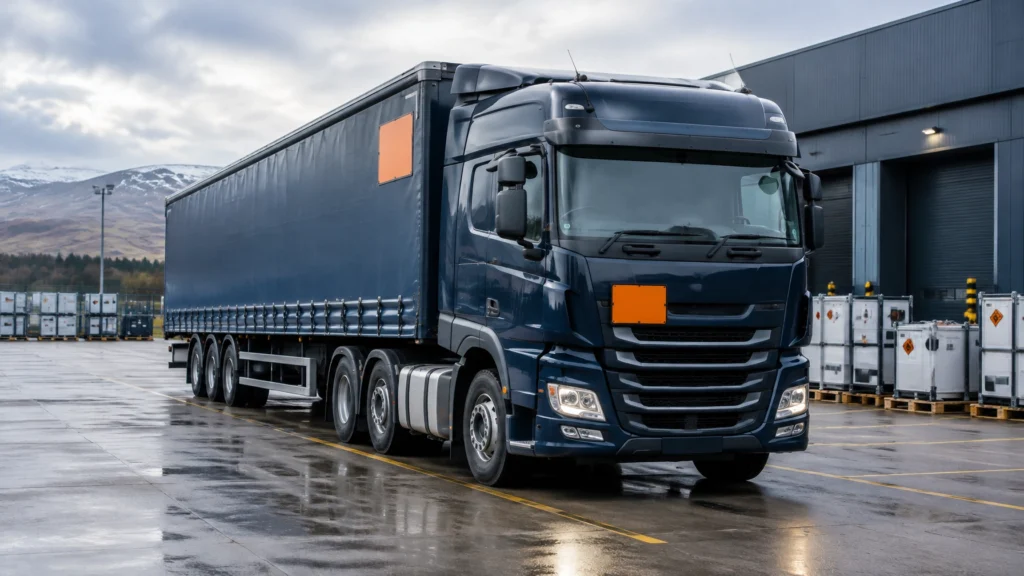
Cargo transport units carrying batteries assigned to these entries must display orange-coloured plates showing the relevant hazard identification number and UN number.
The reported hazard identification number for these entries is 90.
This directly affects vehicle and container equipment. You should check:
- Whether you have the correct orange plates available.
- Whether the correct UN number can be displayed.
- Whether your existing procedures rely only on the old UN 3536 entry.
- Whether the vehicle or container equipment is suitable for the loads you accept.
Do not assume that a generic set of plates will be enough. The chemistry and correct UN entry now matter.
4. What about hybrid lithium-ion and sodium-ion batteries?
4.1 How are hybrid batteries classified?
New special provision 410 clarifies the treatment of batteries combining lithium-ion and sodium-ion cells.
Depending on the configuration, these batteries are assigned to:
- UN 3480
- UN 3481
- UN 3536
If the load is carried under special provision 188, the rated energy must not exceed 100 Wh. The rated energy must also be marked on the outer casing.
This is a classification issue for consignors and manufacturers, but it affects the carrier and driver too. Your transport documents, package markings and loading instructions must all match the classification supplied.
5. Damaged or defective batteries: more information is required
Returned electronics and batteries from repair shops or recycling operations deserve particular attention.
New special provision 680 applies when lithium and sodium-ion batteries are carried in packagings under P911 or LP906.
The consignor must provide the loader and carrier with a description of the conditions under which the packaging may be used and carried. That description must be attached to the transport document.
In practice, you should agree in advance:
- Who prepares the description.
- Who checks it before loading.
- How it is attached to the transport document.
- What the carrier does if the description is missing.
- How drivers are told about any job-specific conditions.

Do not leave this until the driver arrives. A missing description can turn a straightforward collection into a very long coffee break.
6. Hydrogen-related changes
ADR 2027 also introduces changes concerning hydrogen.
New special provision 413 covers liquid organic hydrogen carriers. It sets a threshold for traces of physically dissolved hydrogen at 0.5 litres of hydrogen per kilogram of liquid organic hydrogen carrier.
Special provision 679 allows composite pressure vessels designed for compressed hydrogen, UN 1049, to be carried filled with compressed nitrogen, UN 1066, for example during servicing and maintenance. This is subject to specified pressure limits.
Electric and hydrogen-powered vehicles have been allowed to carry dangerous goods in the FL and AT categories since ADR 2025. If this affects your fleet, you should review your existing procedures rather than treating ADR 2027 as an isolated battery amendment.
7. Tanks, packagings, diesel and HVO
7.1 Fibre-reinforced plastic tanks
New section 6.9.3 covers requirements for the service equipment of fibre-reinforced plastic tanks.
Tank operators and maintenance teams should identify whether their equipment falls within the updated requirements. Your inspection, maintenance and purchasing processes may need to reflect the change.
7.2 Recycled plastics
ADR 2027 also makes it easier to use recycled plastics in selected packagings.
Packaging manufacturers and users should check whether the changes apply to the drums and jerricans they use. Do not change packaging specifications without checking the relevant approval and performance requirements.
7.3 Table A and HVO
Four new UN numbers are added to Table A. One entry, UN 2941, is deleted. Around 185 other entries are amended.
These amendments include diesel fuel, UN 1202, where paraffinic fuels such as HVO are now covered.
That matters to UK fleets already running HVO or planning to introduce it. You should check your fuel classification, transport documentation and internal dangerous-goods procedures.
8. Instructions in writing: a separate deadline
The wording of the instructions in writing in section 5.4.3 is changing.
The current versions may be used until 31 December 2027. After that, drivers must carry the new version in the cab.
This is separate from the general ADR transition ending on 30 June 2027. You therefore need to manage two dates:
- 1 July 2027 for the mandatory ADR 2027 requirements.
- 1 January 2028 for the new instructions in writing.
The GOV.UK guidance on driving dangerous goods and special loads explains the importance of carrying the required transport documents and emergency instructions in writing.
9. Driver training and remote delivery
9.1 Can ADR driver training be delivered remotely?
ADR 2027 explicitly allows remote training and e-learning for drivers under section 8.2.2.
Initial training may be delivered:
- In a classroom.
- Remotely.
- As a combination of classroom and remote learning.
However, practical exercises must still take place on site.
Refresher training may also be delivered as e-learning within defined limits.
There is an important UK point. The current UK authorisation for remote delivery of ADR driver training theory, authorisation 1013, runs only until 31 December 2026. You should confirm the current position with your training provider rather than assume that either the ADR 2027 wording or the existing UK authorisation automatically answers the question.
ADR 2027 also makes clear that Chapter 1.3 applies not only to employees but to all persons whose duties involve dangerous goods, including self-employed people.
That may include consignors, warehouse staff, loaders, transport planners and other people involved in the movement of dangerous goods. Your training matrix should reflect the work people actually do.
10. How ADR training can help you prepare
This is a good time to review your ADR certification and your job-specific dangerous-goods training.
At Open Road Training Ltd, our ADR training covers classes 1, 2, 3, 4, 5, 6, 8 and 9. Class 7 radioactive is not part of our course.
Our five-day ADR course runs as follows:
| Day | Module |
|---|---|
| Monday | Core module |
| Tuesday | Remainder of Core and Packages module |
| Wednesday | Tanks module |
| Thursday | All Classes |
| Friday | Exam Day |
Up to 28 hours of Driver CPC can be attached to the course.
The full course is £559 all in. A refresher course is £350.
Our ADR courses run every month. You can check the latest course dates and plan your training before the January 2027 changes arrive.
We also deliver DGSA courses, dangerous-goods consignor courses and security of dangerous goods courses. These can help you review the wider responsibilities around classification, documentation, loading and handling.
11. Your pre-2027 checklist
Before the new requirements arrive, you should:
- Check your classifications
Identify the batteries you carry and confirm whether they are installed in a cargo transport unit. Record the chemistry and correct UN number. - Update your systems
Review your TMS, dangerous-goods software and transport-document templates. - Check vehicle and container equipment
Make sure you can display the correct orange plates and UN number. - Review instructions in writing
Obtain the new version when required and plan for the 31 December 2027 deadline. - Agree responsibilities for damaged batteries
Decide who prepares the description of carriage conditions under special provision 680. - Update training and checklists
Include consignors, loaders, warehouse staff, drivers and other people whose duties involve dangerous goods. - Review subcontractors
Check that subcontracted carriers understand the revised classifications, documentation and marking requirements. - Review packaging and tank specifications
Check whether the amendments affect the drums, jerricans, tanks or other equipment you purchase and use. - Check customer contracts
Make sure customers understand who provides the classification, descriptions and transport information.
12. Summary: do not wait for 1 July 2027
ADR 2027 takes effect on 1 January 2027, with the main transition ending on 30 June 2027.
The most visible battery change is the split of UN 3536 into:
- UN 3536 for lithium-ion batteries installed in a cargo transport unit.
- UN 3563 for lithium-metal batteries installed in a cargo transport unit.
- UN 3564 for sodium-ion batteries installed in a cargo transport unit.
You should also review hybrid batteries, damaged or defective batteries, orange plates, instructions in writing, HVO, packaging, tanks and training responsibilities.
Your ADR certification and your instructions in writing both need attention. Preparing now gives you time to check the details with customers, drivers, subcontractors and your training provider.
Open Road Training Ltd is a DVSA-approved ADR training body based at 29 Hope Street, Motherwell, ML1 1BS, conveniently opposite Motherwell train station.
To discuss an ADR course, refresher training or dangerous-goods training for your team, call 01698 598 665 or email info@open-road.org. You can also view upcoming course dates.