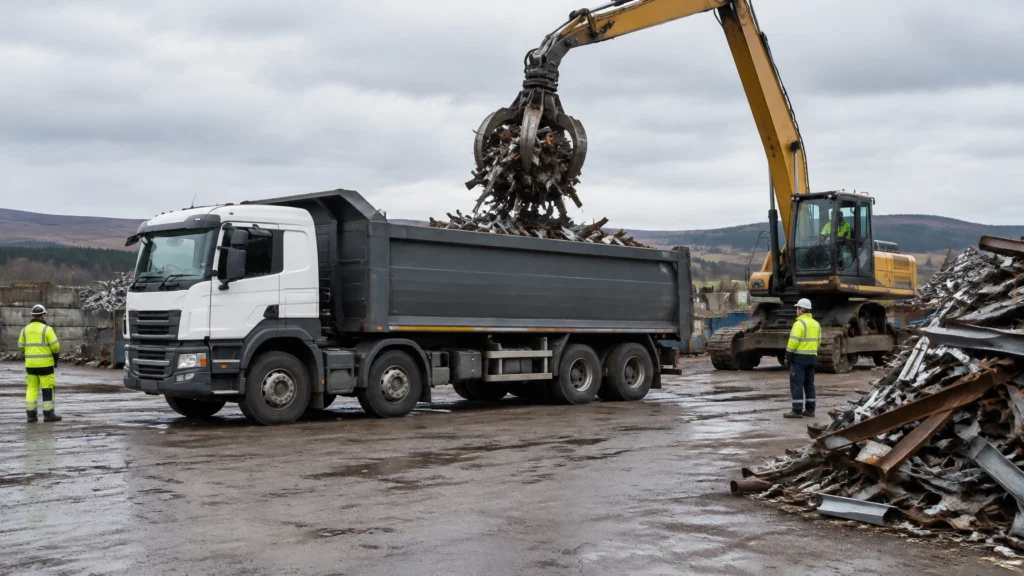
The short answer is: it depends on what the tipper is carrying.
A load of clean, solid scrap metal is generally not dangerous goods under ADR. But certain metal fines, lithium batteries, gas cylinders and contaminated waste can change the answer. The key is to assess the actual load and get its classification confirmed before dispatch, not to assume that every scrap load is dangerous, or that none are.
1. Does ordinary scrap metal need ADR?
Usually, no. Clean, inert scrap such as old steel, crushed vehicle body panels, copper, aluminium, brass and mixed ferrous and non-ferrous metal is generally not classified as dangerous goods under ADR.
If the load is not dangerous goods, the driver does not normally need an ADR driver training certificate just to carry it. ADR transport documentation and dangerous-goods vehicle markings are not required for that load either.
That does not remove your other duties as a waste carrier. Waste transfer documentation, safe loading, load security and any relevant environmental requirements still matter.
1.1 What could change the answer?
The classification depends on the material’s condition and contents. Metal fines, oily residues, batteries or other hazardous items mixed into the load may need a separate assessment. A description such as “scrap metal” on a booking sheet is not, on its own, a dangerous-goods classification.
2. Which scrap loads may be dangerous goods?
Some less obvious loads need closer attention.
2.1 Ferrous turnings, borings and swarf
Under the ADR entry UN 2793, FERROUS METAL BORINGS, SHAVINGS, TURNINGS or CUTTINGS in a form liable to self-heating, certain ferrous fines can be Class 4.2: substances liable to spontaneous combustion.
The important words are “in a form liable to self-heating”. Not every piece of swarf automatically meets this description. Freshly machined fines may self-heat, particularly when contaminated with cutting oil, moisture or other combustible material. Have the actual material assessed rather than applying the entry to all metal turnings.

2.2 Batteries, cylinders and contaminated material
Mixed scrap can contain hazardous articles that were not obvious when the load was booked:
- Lithium-ion batteries can be concealed in discarded equipment. Damaged or defective batteries are a recognised fire hazard in waste and recycling streams. Depending on their condition and how they are presented, batteries may need their own classification; they do not simply become UN 2793.
- Gas cylinders and aerosols can contain compressed or flammable gas, even when they appear empty.
- Industrial or contaminated waste may contain substances that need to be classified and consigned separately.
- Asbestos-containing material needs specialist assessment and handling. Do not treat it as ordinary clean scrap.
A mixed load may therefore need more than one classification decision. If you cannot identify what is in it, pause and get competent advice before accepting or moving it.
3. Who decides whether the load is dangerous goods?
The consignor, the person or business tendering the load, is responsible for correctly classifying dangerous goods and providing the required information and documentation to the carrier.
That does not mean the driver or haulier has no responsibility. HSE explains that ADR assigns duties to different people involved, including consignors, carriers, loaders and unloaders. A carrier should not ignore paperwork that appears incomplete or inconsistent.
As a practical first step, ask the customer:
- Has this load been assessed for dangerous-goods classification?
- Is it being consigned as dangerous goods?
- Can you provide the classification and any required transport information in writing?
Keep a record of the response. If the customer cannot answer, ask them to consult their Dangerous Goods Safety Adviser (DGSA) or arrange a classification check before the vehicle arrives.

4. What if the load is classified as dangerous goods?
If the load is dangerous goods, you must check the requirements for that specific classification and carriage method before the vehicle moves. These may include:
- A valid ADR driver training certificate covering the applicable class and type of carriage.
- A vehicle or bulk container suitable for the authorised carriage method.
- Correct vehicle markings, placards and required equipment.
- The required transport document and emergency information.
A bulk tipper is not automatically suitable for carrying dangerous goods in bulk just because it can tip. Check the relevant ADR requirements for the substance and the specific body or container. The carrier must also check the paperwork and vehicle requirements; do not rely on the driver to resolve an uncertain classification at the gate.
The GOV.UK guidance on driving dangerous goods and special loads outlines driver training and documentation requirements. HSE’s guidance on consignment procedures explains the responsibilities shared across the supply chain.
5. Temperature monitoring for self-heating ferrous fines
Self-heating metal fines require careful controls. Fires in scrap shipments have been linked to self-heating material and contamination. Fire risk is not a reason to label all scrap dangerous; it is a reason to assess suspect material properly.
Industry guidance for shipping self-heating ferrous fines recommends keeping the cargo as dry as possible and monitoring surface temperatures before and during loading. It gives these practical thresholds:
| Temperature check | Shipping guidance |
|---|---|
| During loading | Stop loading if temperatures exceed 90°C. |
| Before carriage | Do not carry the cargo unless temperatures are below 65°C and trending downwards. |
| Cargo handling | Compaction can help reduce exposed surface area and air access. |
These figures come from shipping-industry guidance for self-heating cargo. They are not universal ADR road temperature limits. If a journey includes sea transport, check the applicable maritime requirements and the carrier’s procedures as well as ADR. Do not use these numbers as a substitute for a competent assessment or the correct transport controls.
A single fire in a tipper at a yard or on the motorway is a costly and dangerous way to learn that a load needed better checks. If material is hot, smoking or behaving unusually, stop and follow your site emergency procedures. Do not load it and hope for the best.
6. What training do your drivers and staff need?
If the load is not dangerous goods, an ADR driver certificate is not normally required for that journey. But if your business is involved in carrying dangerous goods, ADR Chapter 1.3 requires relevant personnel to receive training appropriate to their responsibilities. Awareness training can also help staff who may encounter dangerous goods unexpectedly.
Drivers, loaders, office staff and managers do not all need the same training. The right choice depends on what each person does. For example, a driver who carries classified dangerous goods may need an ADR driver certificate, while a loader or planner may need awareness and function-specific training.
7. What is changing for ADR in 2027?
ADR 2027 is due to come into force on 1 January 2027. ADR 2025 may be used during the general transition until 30 June 2027; the new requirements become mandatory from 1 July 2027. If you handle scrap or battery-rich waste streams, review your procedures ahead of the change.
ADR 2027 also splits the entry for lithium batteries installed in cargo transport units. The revised entries distinguish lithium-ion, lithium-metal and sodium-ion batteries: UN 3536, UN 3563 and UN 3564 respectively. This specific change concerns batteries installed in cargo transport units; it does not classify every loose battery in scrap under those numbers. Check the actual battery type and circumstances.
The UK’s remote-delivery authorisation for ADR driver training, Authorisation 1013, runs until 31 December 2026. Under the current authorisation, theory elements may be completed remotely, but individual practical elements must be completed in person. There will be no further authorisations, as the UK will align with ADR 2027 from 1 January 2027. If you are arranging training for 2027, confirm the current delivery arrangements with your provider. You can check the GOV.UK information on ADR driver training and the remote-delivery authorisation.
8. How Open Road Training can help
Open Road Training Ltd is a DVSA-approved ADR training body. Our five-day course runs Monday to Friday:
- Monday: Core module.
- Tuesday: Remainder of Core and Packages module.
- Wednesday: Tanks module.
- Thursday: All Classes.
- Friday: Exam Day.
The course covers ADR Classes 2, 3, 4, 5, 6, 8 and 9. Class 7 radioactive and class 1 explosives are not included. Class 4.2 covers self-heating ferrous fines, while Class 9 includes topics such as lithium batteries.
The full course is £559 all in; a refresher is £350. Up to 28 hours of Driver CPC can be attached, subject to eligibility. ADR and Driver CPC courses run every month. We also provide ADR awareness, DGSA, dangerous goods consignor and security of dangerous goods courses.
For drivers who also need Driver CPC hours, courses are scheduled during the week commencing 19 November 2026, at £60 per day or £300 for the full week, starting at 8am. Check the Course Dates page for current details.
Our training centre is at 29 Hope Street, Motherwell, ML1 1BS, opposite Motherwell train station. We can help you choose suitable training for your role or your team.

9. Summary: does your scrap metal bulk tipper need ADR?
| What’s on the tipper? | Is it dangerous goods? | What you need to do |
|---|---|---|
| Clean, inert solid scrap metal | Generally not | Confirm what the load contains; ADR is not normally required for that load. |
| Ferrous fines or turnings liable to self-heat | May be UN 2793, Class 4.2 | Get the material classified and check ADR bulk-carriage requirements. |
| Scrap with batteries, cylinders or aerosols | It depends on the articles and their condition | Identify and classify the items; do not assume they are covered by the scrap description. |
| Contaminated industrial waste | May be dangerous goods | Ask the consignor for the classification and consult a DGSA if needed. |
The reliable answer is “it depends on the load.” Ask the consignor for a written classification, check the transport information and get expert advice when contents are uncertain. If your team needs help with ADR training or dangerous-goods awareness, call 01698 598 665 or email info@open-road.org.