1. The short answer: two licensing jurisdictions, not one
Great Britain (GB) and Northern Ireland (NI) have separate goods vehicle operator licensing regimes. Cabotage between Great Britain andNorthern Ireland is also subject to specific rules that operators must be aware of. GB licensing is governed by the Goods Vehicles (Licensing of Operators) Act 1995; NI has its own regime under the Goods Vehicles (Licensing of Operators) Act (Northern Ireland) 2010.
A GB operator’s licence does not, by itself, authorise domestic goods carriage in NI. Nor does an NI licence, by itself, authorise domestic goods carriage in GB. The two regimes also have separate applications, financial standing assessments, operating centres, transport manager nominations and fees. Specific statutory exemptions can apply, so the right answer depends on your operation and the authority you hold.
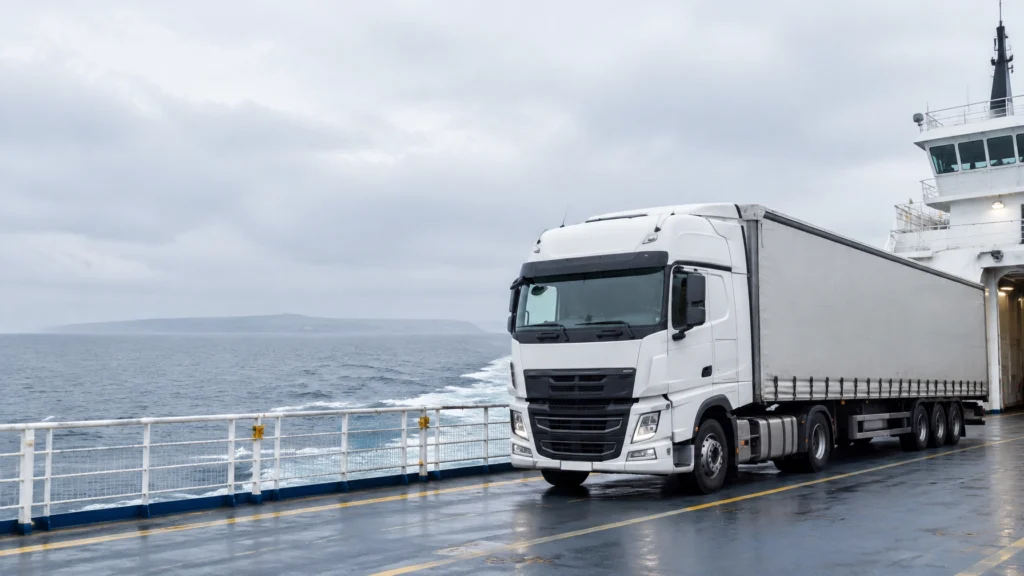
A journey from Coventry to Belfast, or Cairnryan to Larne, does not become cabotage simply because it crosses the Irish Sea. Cabotage is national carriage in a host country by a haulier established elsewhere. For GB and NI work, check which licensing rules apply to each part of the operation, and whether a particular exemption covers it. A ferry crossing is not a magic licence extension.
One important boundary before we go further: coach operators and haulage operators are licensed under different legislation, with different licence types, fees and cabotage rules. Section 3 sets out where the two diverge. Everything else in this article is about goods vehicles.

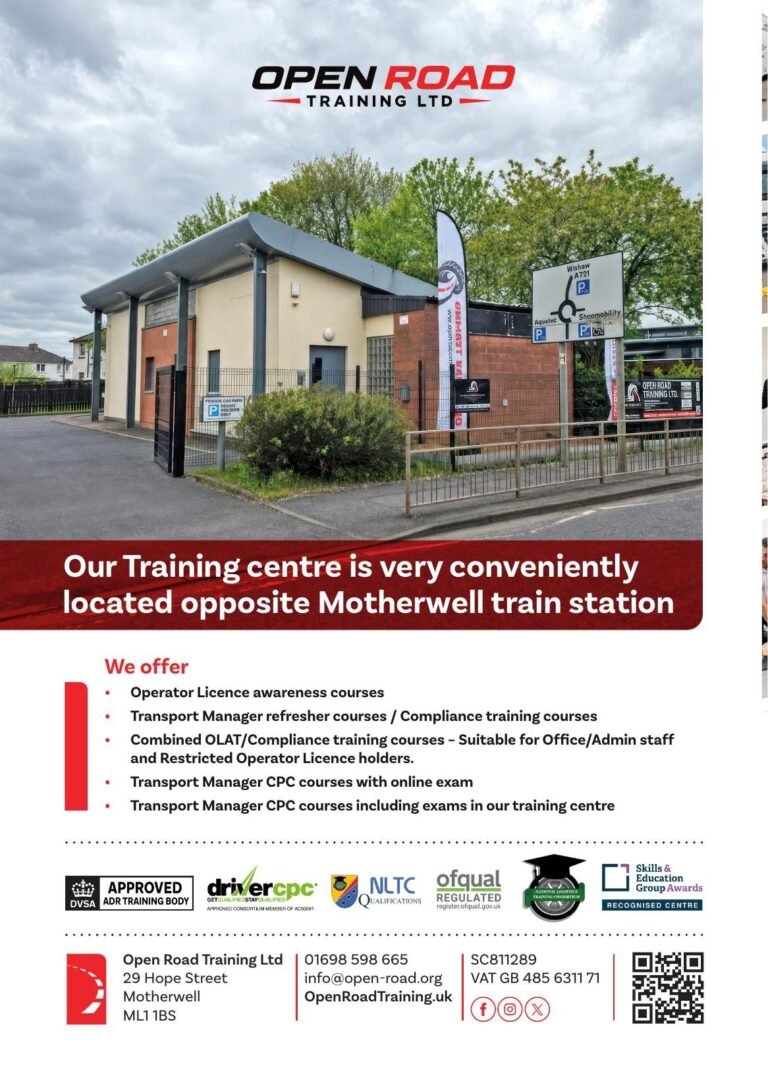
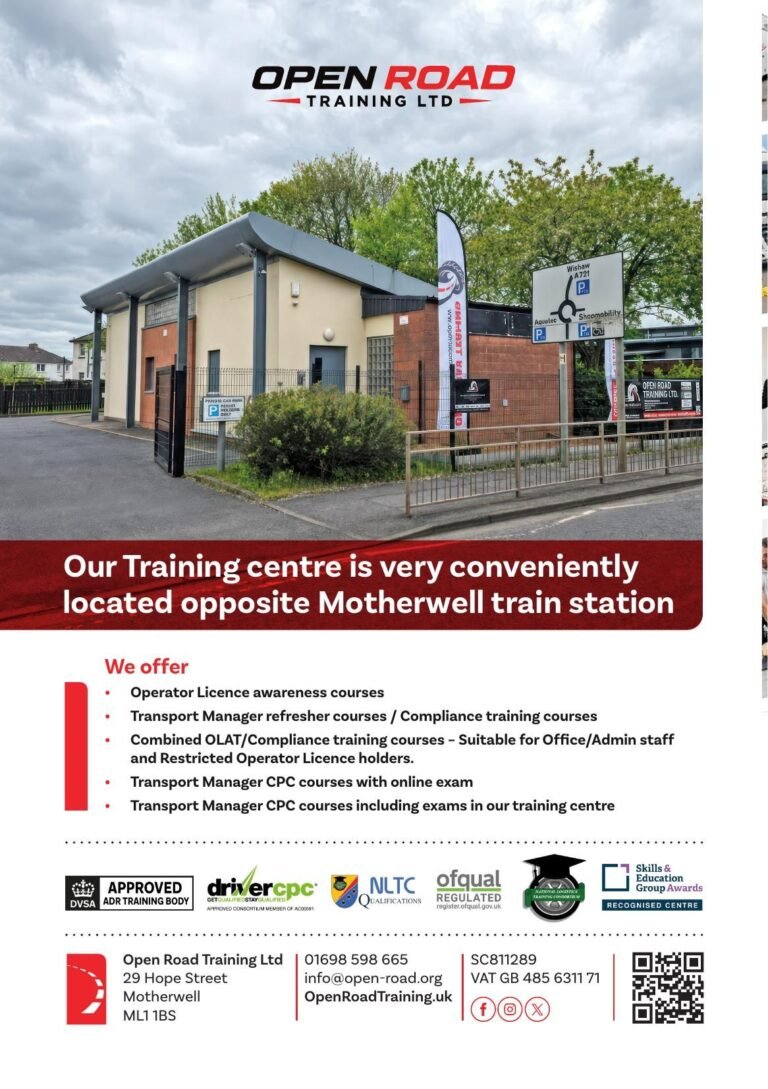
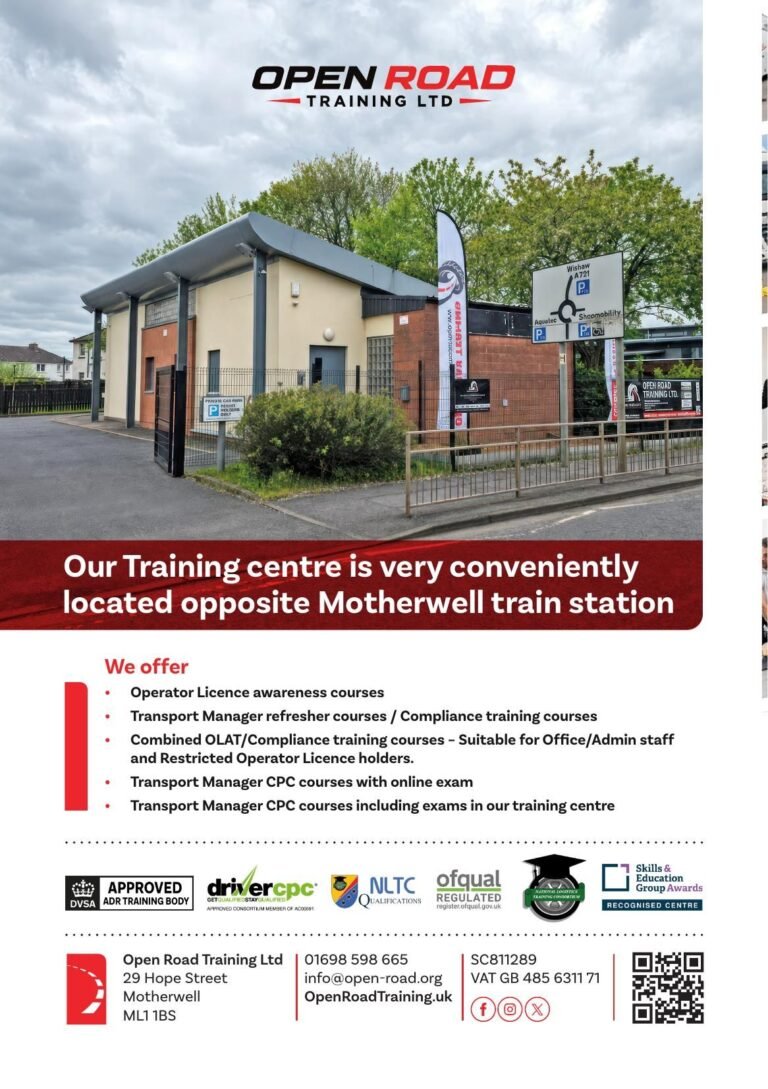
You can view the Open Road Training brochure for an overview of our training.
2. What does cabotage actually mean?
Cabotage is national carriage for hire or reward, carried out temporarily in a host country by a haulier established in another country. Under the UK–EU Trade and Cooperation Agreement arrangements and assimilated Regulation (EC) No 1072/2009, an eligible haulier with a valid Community Licence may carry out up to two cabotage operations in the UK after completing an incoming laden international journey.
In plain terms:
- The incoming journey must be laden. The goods brought into the UK must be delivered before cabotage operations can begin.
- The limit is two operations. The haulier cannot keep doing domestic jobs as if it were permanently based here.
- The seven-day clock matters. The last unloading of a cabotage operation must take place within seven days of the last unloading of the incoming international carriage.
- The evidence must travel with the vehicle. The driver must be able to produce clear evidence of the incoming international carriage and each cabotage operation.
This is a limited opportunity for an eligible international operator to make efficient use of a trip, not a route to running a permanent domestic operation. See the GOV.UK international road haulage guidance.
3. Coach operators and haulage operators: same principle, different regime
The shared principle is that you need the licence which matches the jurisdiction you are operating in. But the resemblance between a haulage operation and a coach operation largely ends at the licence principle.
In Great Britain, goods vehicle licensing comes from the Goods Vehicles (Licensing of Operators) Act 1995. Passenger transport comes from the Public Passenger Vehicles Act 1981. A coach operator and a haulier working from the same yard therefore hold different licences, apply through different processes and pay different fees.
| Haulage (goods vehicles) | Coach and bus (passenger transport) | |
|---|---|---|
| Governing legislation (GB) | Goods Vehicles (Licensing of Operators) Act 1995 | Public Passenger Vehicles Act 1981 |
| Licence types | Restricted, standard national, standard international | Restricted, standard national, standard international, plus special restricted (taxi) |
| Application fee (GB) | £257 | £209 for standard or restricted; £61 for special restricted (taxi) |
| Issue and continuation | £401 to issue; £401 continuation fee every 5 years | No expiry date, but the Office of the Traffic Commissioner asks you to confirm your details every 5 years; a £61 continuation fee applies only to special restricted (taxi) licences |
| Change to the licence | £257 for a major change | £122 |
| Financial standing | £3,100 first vehicle and £1,700 each additional on a restricted licence; £8,000 and £4,500 on a standard licence | The same published thresholds apply to passenger service vehicles |
| Cabotage allowance | Up to two operations in seven days following a laden incoming international journey, under the Trade and Cooperation Agreement and Regulation 1072/2009 | Far narrower. Under the TCA, passenger cabotage is permitted only for services between Northern Ireland and Ireland, and not elsewhere in the EU or among Interbus Agreement contracting parties |
| Extra requirements | None of the below | Local bus service registration with the Traffic Commissioner, and accessibility rules under PSVAR for in-scope vehicles |
Fees change from time to time, so check the current GOV.UK guidance before you budget.
The cabotage difference is the one that catches people out. Hauliers have a well-known two-in-seven allowance. Coach cabotage is a much narrower permission: under the TCA it is limited to services between Northern Ireland and Ireland, and it is not available elsewhere in the EU or among Interbus Agreement parties. A coach operator cannot treat a haulage cabotage allowance as authority for a tour or a scheduled service. International coach work turns on different questions entirely, such as Interbus authorisations and permits.
Local bus registration is another coach-only process. Running a registered local bus service in GB involves registering the service with the Traffic Commissioner, separately from holding the licence, with its own timescales for registering, varying or cancelling. There is no equivalent step in goods licensing.
And the guidance is separate too. Goods operators work from the goods vehicle operator licensing guide; coach and bus operators need the PSV operator licensing guide. Reading the wrong one is an easy mistake when a mixed business runs both.
What carries across is the principle. If you run coaches between GB and NI, the same jurisdictional question applies: which licence authorises this particular service, and where is it actually being operated? The Johnston case below was about lorries, but its reasoning on what counts as “temporary” and on evidence at the roadside reads across to passenger operations.
4. What happened in Belfast? The Johnston case
In Johnston v Driver and Vehicle Agency [2025] UKUT 170 (AAC), two Bulgarian-registered large goods vehicles and coupled trailers were detained by enforcement officers in Belfast on 21 September 2023. Neither vehicle was on an operator’s licence issued under the NI 2010 Act.
The driver of the first vehicle said the vehicles were carrying out cabotage under a Community Licence. But the evidence raised questions about how temporary the operation really was. The driver had an Irish driving licence and digital tachograph card, a County Monaghan address, a UK mobile number and Driver CPC completed in NI. The vehicle had UK-style plates and UK-dipped headlights, and its tachograph had been locked in by an NI-based operator. Trailer 1 was registered to an NI keeper. There was no evidence of goods being carried to, from or within Bulgaria.
The second vehicle raised separate concerns. Its tachograph had not been downloaded for 1,334 days, the Community Licence relied on had been terminated in 2019 for lack of financial standing, and the vehicle had no valid annual roadworthiness certificate.
The NI Presiding Officer found the vehicles lawfully detained and directed their disposal. The Upper Tribunal dismissed the appeal, finding no basis to disturb the decision as “plainly wrong”. The vehicles and one trailer had to be disposed of.
5. What did the Upper Tribunal decide?
The cabotage exemption in paragraph 23 of the NI Exemption Regulations requires three things:
A vehicle must be used for national carriage for hire or reward, on a temporary basis in the United Kingdom, and in accordance with Regulation 1072/2009.
These are cumulative conditions: all three must be met.
For the first vehicle, the Tribunal accepted that the carriage was for hire or reward and that the Regulation 1072/2009 cabotage requirements were met. The vehicle had completed a laden incoming international journey and there was evidence of a subsequent movement from Cambridgeshire to Killinchy. But the exemption still failed because the vehicle was not in the UK on a temporary basis. Its connections to Northern Ireland outweighed its connections to Bulgaria.
The Tribunal described “flagging out”: registering a vehicle in a country other than the country it really operates from, usually for commercial advantage. It found nothing erroneous in the decision-maker using that term.
For the second vehicle, the incoming journey to the UK was found to have been unladen. The Tribunal said Article 8(2) implies that the incoming international journey must be laden. Documents produced months later also lacked credibility. The case is a practical warning: having a licence document is not enough if the operation and the evidence do not support the exemption.

6. Three lessons from the case
6.1 Temporary means temporary
“Temporary” is a question of fact, not simply what you intended. The Tribunal considered the whole picture: vehicles, trailers, drivers, tachograph records, business links and vehicle features. A fleet with strong local connections may not look like an international operator briefly carrying out work here.
6.2 Evidence belongs in the cab
Article 8 requires clear evidence of the incoming international carriage and each consecutive cabotage operation. Keep the relevant consignment documents accessible to the driver. In Johnston, evidence produced later did not repair the lack of credible roadside proof.
6.3 Similar rules do not mean one licence
The Tribunal observed that relevant provisions in the 1995 Act for GB and the 2010 Act for NI are in near-identical terms. It considered this a deliberate choice to maintain a common standard, so decisions interpreting matching provisions can be relevant on either side.
That does not make the licences interchangeable. You still need to establish which licence or statutory exemption covers your particular movement.
7. What should you check before loading?
| Type of movement | What to check |
|---|---|
| Domestic carriage within GB | Does your GB operator’s licence authorise the operation? |
| Domestic carriage within NI | Does your NI operator’s licence authorise it, or does a specific exemption apply? |
| Genuine cabotage by an eligible non-resident haulier | Is the Community Licence valid? Was the incoming international journey laden? Are there no more than two operations within the seven-day limit? Is clear evidence in the vehicle? |
Before dispatch, check:
- Where are the goods loaded and unloaded? Identify whether the work is domestic within GB, domestic within NI, or another kind of movement.
- Which licence or exemption applies? Do not assume that one operator’s licence authorises every domestic movement on both sides of the Irish Sea. Check the GB operator licensing guide and NI legislation, including the 2010 Act explanatory notes.
- If you rely on cabotage, can the driver prove every condition roadside? Check the incoming laden journey, the operation count, the seven-day period and the documents for each movement.
- Does the operation genuinely look temporary? Review your business establishment, vehicle and trailer arrangements, driver records and operating patterns.
- Do your records tell one consistent story? A licence, tachograph data, consignment notes and operator details should agree.
If you regularly carry out domestic work in both GB and NI, you may need separate licences, subject to applicable exemptions. Separate applications mean requirements such as financial standing, operating centres, transport manager nominations and fees must be considered under each regime.
If you operate coaches as well as lorries, work through section 3 before you plan the movement. A haulage licence does not authorise a coach service, and a haulage cabotage allowance does not authorise coach cabotage.
8. What is the Transport Manager’s role?
Your Transport Manager should help make sure the operation is compliant before the vehicle leaves, not after an enforcement stop. That includes checking which licence or exemption covers the movement, confirming that cabotage conditions are met and ensuring the driver has the right documents.
Continuous and effective management must include cross-border work. A transport manager cannot manage compliance properly if they do not know which journeys are being planned or what evidence drivers carry.

Our two-day Transport Manager CPC Refresher and Compliance Awareness course is built around DVSA expectations and the questions an auditor actually asks. You will find the course details in our training brochure.
9. Training and next steps
Open Road Training offers a two-day Transport Manager CPC Refresher and Compliance Awareness course for £350 plus VAT, for road haulage and passenger transport. Up to seven hours of Driver CPC per day attended may be available, subject to eligibility.
We also offer Operator Licence Awareness Training (OLAT), with an Ofqual-regulated qualification or attendance-only option. Seven hours of Driver CPC may be available, subject to eligibility. The Traffic Commissioner increasingly asks for evidence of transport management experience or OLAT completion.
If you need the full qualification, Transport Manager CPC training is available for road haulage and passenger transport. The home-study option is £650 and includes six months of eLearning, printed manuals, remote learning and online exams. Examinations are through Skills and Education Group Awards (SEG Awards). Candidates can add up to 35 hours of Driver CPC for £75, subject to eligibility.

You can check course dates or view our training brochure. We are at Open Road Training Ltd, 29 Hope Street, Motherwell, ML1 1BS, opposite Motherwell train station. Call 01698 598 665 or email info@open-road.org.
10. Summary
- GB and NI have separate goods vehicle operator licensing regimes.
- Coach operators and haulage operators work under different legislation, licence types, fees and cabotage rules; a licence for one is not a licence for the other.
- A journey across the Irish Sea is not automatically cabotage.
- Cabotage requires a laden incoming international journey, no more than two operations within the seven-day limit, and clear evidence.
- The Johnston case shows that compliance with the cabotage movement limits does not, by itself, prove that the operation is temporary.
- Keep paperwork in the cab and confirm which licence or exemption covers each movement.
- Your Transport Manager should check these arrangements before dispatch.

Sources
- *Johnston v Driver and Vehicle Agency [2025] UKUT 170 (AAC)
- International road haulage: jobs inside an EU country or between EU countries, GOV.UK
- Goods vehicle operator licensing guide: GOV.UK
- Public service vehicle operator licensing guide: GOV.UK
- Apply for a vehicle operator licence, including current fees: GOV.UK
- Public Passenger Vehicles Act 1981
- Goods Vehicles (Licensing of Operators) Act (Northern Ireland) 2010: explanatory notes