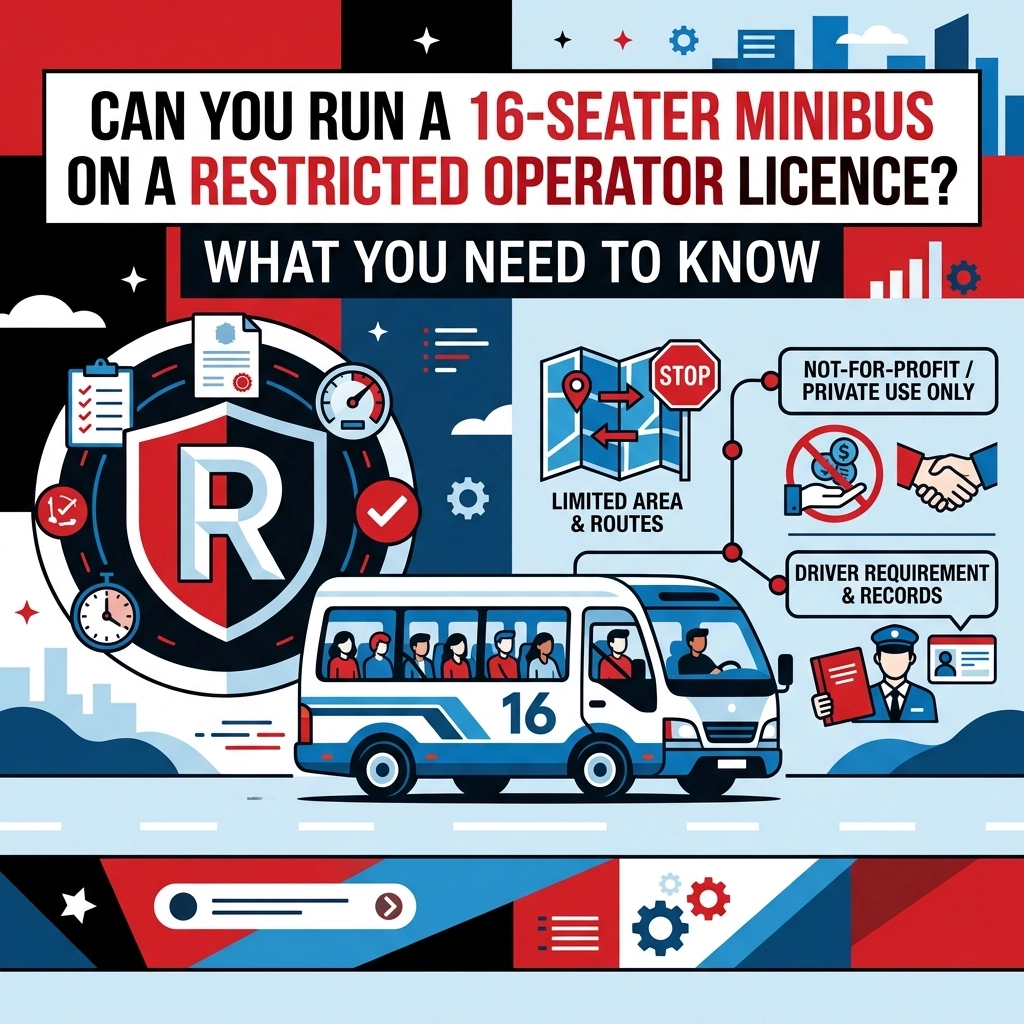
If you are involved in the world of passenger transport, you know that the rules and regulations can feel like a maze. One of the most common questions we get here at Open Road Training Ltd is: "Can I run a 16-seater minibus on a restricted operator licence?"
The answer is a bit of a "yes, but…" scenario. It’s a hot subject, and for good reason. Get it wrong, and you’re looking at heavy fines or even having your vehicle impounded. Get it right, and you can operate efficiently without the overheads of a full standard licence.
In this post, we’re going to break down the rules directly from the source, explain the "main occupation" rule, and show you why even if you can operate on a restricted licence, you might still want to join us for our next Transport Manager CPC course.
1. Understanding the PSV Restricted Operator Licence
When we talk about PSV (Public Service Vehicle) licences, we are looking at how you carry passengers for "hire or reward." If people are paying you to move them from A to B, you are in the world of operator licensing.
1.1 What is a Restricted Licence?
A restricted licence is designed for businesses or organisations that don't have passenger transport as their primary activity. Think of a hotel that runs a shuttle to the airport, or a sports club taking its team to away games.
According to the official GOV.UK guidance, a restricted licence allows you to:
- Use no more than two vehicles.
- Carry between 9 and 16 passengers in those vehicles.
1.2 The Two Vital Conditions
While you can technically run a 16-seater, you must meet two very specific criteria:
- Condition A: The vehicle is not used as part of a passenger transport business.
- Condition B: Operating the vehicle is a "sideline" to your main occupation or business activity.

2. The "Main Occupation" Rule: The Biggest Pitfall
This is where most people get caught out. You cannot simply set up a "minibus company" and apply for a restricted licence because you only want one or two vans. If your main source of income is moving people, you are a passenger transport business.
2.1 What counts as a "Sideline"?
Imagine you run a construction company. You use a 16-seater minibus to transport your workers from a central pick-up point to a remote site. Your "main occupation" is construction. The transport is just a way to get the job done. This would generally qualify for a restricted licence.
Now, imagine you decide to start taking stag and hen parties to the airport on the weekends for extra cash. If that transport work becomes a significant part of your income or your business focus, the DVSA (Driver and Vehicle Standards Agency) will argue that transport is no longer just a "sideline."
2.2 What if I carry more than 16 people?
If you want to move more than 16 passengers, or if you want to run more than two vehicles, the restricted licence is no longer an option. You must move to a Standard National or Standard International licence.
3. Hire and Reward: Are You Taking Money?
"Hire or reward" is a broad term. It doesn't just mean someone handing you a tenner for a lift. It includes any sort of payment that gives a person the right to be carried.
3.1 Direct and Indirect Payments
- Direct: A ticket price or a booking fee.
- Indirect: A "suggested donation," or even a scenario where transport is included in the price of a holiday or a membership fee.
If there is any form of payment involved, you need an operator licence. If your operation is purely non-profit and community-based, you might be looking at Section 19 or 22 permits instead, but for most commercial entities, the restricted licence is the minimum requirement.
4. The Benefits and Risks of a Restricted Licence
Many operators choose the restricted route because it doesn’t legally require you to employ a qualified Transport Manager. However, don't let that fool you into thinking the rules are relaxed.
4.1 The Regulatory Burden
Even on a restricted licence, you are still bound by:
- Drivers' Hours: You must ensure your drivers are sticking to the rules and taking their breaks.
- Vehicle Maintenance: Your 16-seater must be kept in a roadworthy condition with regular safety inspections (usually every 6-10 weeks).
- Record Keeping: You must keep maintenance and driver records for at least 15 months.
4.2 Why Compliance Audits Matter
Because you don't have a dedicated Transport Manager, it is very easy for things to slip through the cracks. We often suggest that restricted licence holders look into a compliance audit to make sure they aren't accidentally breaking the law.

5. Moving to a Standard Licence: Why You Need a Transport Manager
If your business grows or if you realise that transport is actually your main game, you’ll need to apply for a Standard National or International licence.
The biggest difference here? You must have a qualified Transport Manager. This person is legally responsible for ensuring the "continuous and effective management" of your transport operations.
5.1 Can I be my own Transport Manager?
Yes, but you have to pass the Transport Manager CPC (Certificate of Professional Competence) exams. This is a level 3 qualification and it isn't something you can just "wing."
If you don't want to take the exams yourself, you can look at hiring an external transport manager to satisfy the requirements of your licence.
6. Join Our Passenger Transport Manager CPC Course
Whether you are aiming for a Standard licence or you just want to run your restricted operation properly, our Passenger Transport Manager CPC course is the gold standard for training.
We have limited availability for our next course starting next week!
6.1 Why this course is great for Restricted Licence Holders
Even though the law doesn't force you to have a CPC qualification for a restricted licence, the DVSA expects you to have the same level of knowledge regarding maintenance and driver hours.
If you're looking for a transport manager online course or transport manager courses in the UK, we offer a blend of expert tuition and practical advice that makes the complex regs easy to swallow.
6.2 What we cover:
- Business and Financial Management: How to keep the books straight.
- Access to the Market: Understanding the different types of licences.
- Technical Standards: Everything you need to know about vehicle maintenance and weights.
- Road Safety: Keeping your drivers and the public safe.
You can find all our upcoming dates and secure your spot on the Course Dates page.

7. Summary Table: Restricted vs. Standard Licence
| Feature | Restricted Licence | Standard National Licence |
|---|---|---|
| Max Vehicles | 2 | Unlimited (subject to financial standing) |
| Passenger Capacity | 9-16 | Any number |
| Main Occupation | Must be a sideline | Can be the main business |
| Transport Manager | Not required (but recommended) | Mandatory |
| Professional Training | Highly recommended | Essential for the TM |
8. Final Thoughts from Open Road Training Ltd
Navigating the rules for a 16-seater minibus can be tricky. Yes, you can run one on a restricted licence, but you have to be very careful that it remains a sideline to your main business and that you don't grow beyond two vehicles.
If you are feeling a bit overwhelmed by the paperwork, or if you’re ready to take the next step and become a qualified Transport Manager, we are here to help. Our transport manager course online options make it easier than ever to get qualified without having to spend weeks away from your business.
Don't wait until the DVSA pulls you over to figure out if you're compliant. Check out our shop for training materials or book your place on our next course starting next week.
Ready to get started?
Visit our Course Dates page today and let’s get you on the right road!
Disclaimer: This blog post is for educational purposes and based on guidance from GOV.UK. Regulations can change; always check the latest official government advice or consult with a transport professional before making changes to your operating model.