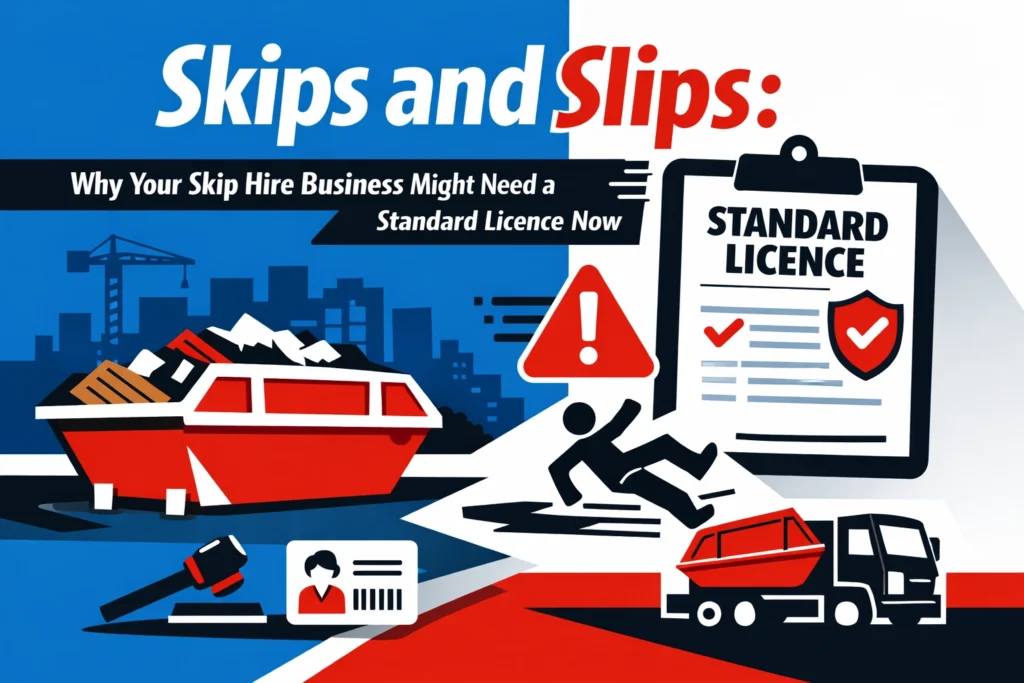
If you are running a skip hire business, you’ve likely spent your career focused on logistics, waste management, and keeping your customers happy. But lately, the phone hasn’t just been ringing with new orders. At Open Road Training, we’ve had a massive influx of calls and emails from operators across the UK asking the same thing: “Do I need a restricted or standard licence for skip hire — and which one applies to me?”
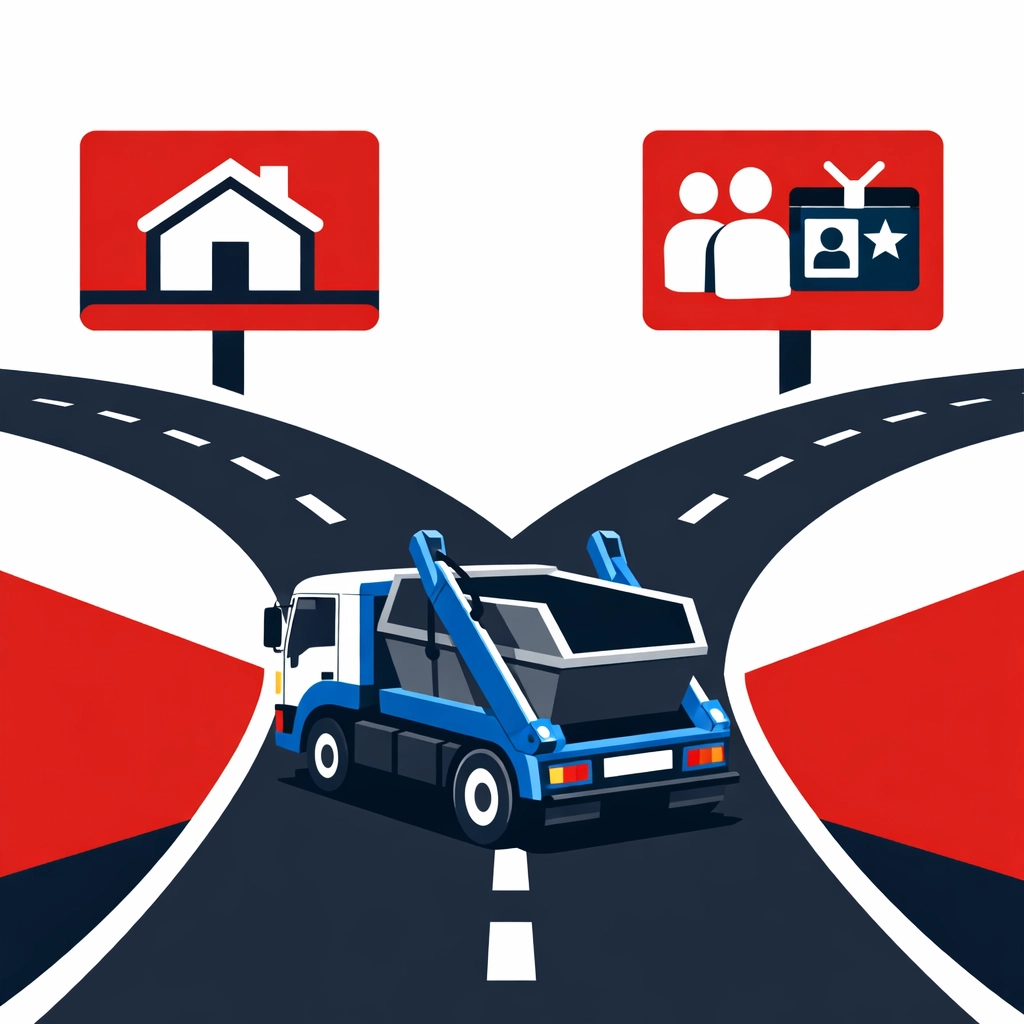
What you’re actually choosing between is a restricted or standard operators licence for skip hire (i.e., the type of Goods Vehicle Operator’s Licence that fits the work you do).
For many skip hire businesses, the honest answer is: you’ll often need a standard licence for skip hire because the Traffic Commissioner may treat the work as hire or reward.
The landscape is shifting. What used to be a “grey area” where many businesses applied for a restricted licence for skip hire is being cleared up by the Traffic Commissioners — and not in the way some operators might hope. If you’re currently operating on a restricted licence, you might be standing on thin ice.
In this post, you’ll learn the practical difference between a restricted or standard licence for skip hire, why Traffic Commissioner rulings (including Wigston Skip Hire) matter, and what you need to do to stay compliant before you end up facing a Public Inquiry.
1.0 The Big Question: Restricted or Standard Licence for Skip Hire
Before we get into the “why,” let’s get clear on the “what.” In the world of transport regulation, there are two operator licence types that matter for skip businesses — and choosing the wrong one is where most problems start.
Here’s the simple difference when you’re deciding on a restricted or standard licence for skip hire:
- Restricted licence for skip hire (Restricted Operator’s Licence): This allows you to carry your own goods in connection with your own trade or business. You cannot carry goods for “hire or reward” (in plain English: you can’t be paid to move other people’s goods).
- Standard licence for skip hire (Standard National Operator’s Licence): This allows you to carry your own goods and goods for hire or reward. To hold this licence, you must show professional competence — which normally means you (or someone in your business) is a qualified Transport Manager.
1.1 Why the Confusion Around a Restricted or Standard Licence for Skip Hire?
For years, lots of skip hire companies argued they were simply transporting “their own” waste. The logic was:
“The customer pays for the skip, the waste becomes mine once it’s in the skip, and I’m just moving my own property back to my yard.”
This means many businesses went for a restricted licence for skip hire because it’s cheaper and it doesn’t require a qualified Transport Manager.
But Traffic Commissioners have been making it clear in rulings and Public Inquiries that (don’t shoot the messenger) this argument often doesn’t hold up — because the customer is paying you to remove waste from their site, and that points directly to hire or reward.
2.0 The Turning Point: Traffic Commissioner Rulings (Including Wigston Skip Hire)
If you want to understand why the restricted or standard licence for skip hire question is getting sharper, you need to look at how the Traffic Commissioners have been deciding these cases at Public Inquiry.
A key example operators refer to is James March T/A Wigston Skip Hire. It’s one of the rulings that’s helped draw a much firmer line when you’re choosing between a restricted or standard licence for skip hire.
2.1 The Case Details
In this instance, the operator was applying for a Restricted Licence. They argued that the primary business was waste disposal and that the transport element was merely incidental. They claimed that once the skip was filled, the contents belonged to the skip company.
2.2 The Traffic Commissioner’s Decision (And What It Means for a Restricted or Standard Licence for Skip Hire)
The Traffic Commissioner (TC) disagreed. The TC’s view was that the primary reason the customer pays the skip company is to have waste removed from their site. Therefore, the transport of that waste is being done for “hire or reward.”
“The transport of the waste is not just incidental to the business; it is the very service being sold.”
This means that even if you claim the waste is “yours” once it’s in the skip, the act of collecting it and moving it as part of a paid service can still be treated as hire or reward.
And once you’re in hire or reward territory, you’re generally into standard licence for skip hire territory — not restricted.
3.0 Why “Hire or Reward” Matters When You’re Choosing a Restricted or Standard Licence for Skip Hire
You might be thinking, “Don’t shoot the messenger, but I’ve been doing this for twenty years on a Restricted Licence!” We hear you. This has been a hot subject recently, and the industry is playing catch-up with these decisions.
3.1 The Economic Reality (Why Many Skip Hire Businesses End Up Needing a Standard Licence)
If a customer pays you £250 for a skip, that fee covers the delivery, the rental, the collection, and the disposal. In the real world, your customer isn’t paying you because they love having a skip on their driveway — they’re paying for waste to be taken away.
Because the collection and transport are part of that paid service, Traffic Commissioners often view it as hire or reward.
This means many skip hire businesses that apply for a restricted licence for skip hire are often found (by the Traffic Commissioner) to actually need a standard licence for skip hire — because you’re transporting waste as part of a paid service (even if the invoice doesn’t split out “transport” as a separate line).
3.2 The Risk of Getting It Wrong
If you are found to be operating for hire or reward on a Restricted Licence, the consequences are severe:
- Impounded Vehicles: The DVSA has the power to take your trucks off the road.
- Public Inquiry: You will be called to stand before the Traffic Commissioner to explain yourself.
- Loss of Licence: You could lose your right to operate entirely, effectively shutting down your business.

4.0 The Missing Piece in a Standard Licence for Skip Hire: The Transport Manager
Once you realise you need a standard licence for skip hire, you hit the next hurdle: professional competence.
A standard licence for skip hire requires you to nominate a qualified Transport Manager. This person is responsible for making sure your operation stays compliant — driver hours, vehicle maintenance, systems, record keeping, and generally keeping you on the right side of DVSA and the Traffic Commissioner.
4.1 Can I be my own Transport Manager?
Yes, absolutely! Many business owners choose to take the Transport Manager CPC (Certificate of Professional Competence) themselves. This gives you total control over your compliance and saves you the cost of hiring an external consultant.
4.2 What if I don’t want to do the paperwork?
If you don’t have the time to manage the compliance yourself, you can hire an External Transport Manager. We actually provide guidance on this at Open Road Training, helping you find the right fit for your business.
5.0 How Open Road Training Can Help (If You Need a Standard Licence for Skip Hire)
We’ve seen a surge in skip operators who’ve realised they likely need a standard licence for skip hire — and that means getting the Transport Manager CPC sorted.
You’re busy running a business, so we keep it flexible. Open Road Training Ltd provides Transport Manager CPC training options for Glasgow, Edinburgh, Online, and Home Study.
5.1 Flexible Study Options (Glasgow, Edinburgh, Online, Home Study)
Pick the route that fits around your wagons and your workload:
- Classroom (Glasgow / Edinburgh options): Best if you want structure, accountability, and the chance to ask questions as you go.
- Online Courses: Study from your office or home at your own pace. Ideal if you need a transport manager online course that fits around skip deliveries.
- Home Study: We provide the materials; you put the time in when it suits you. A popular option if you prefer physical books and independent learning.
5.2 Next Classroom Course: May
If you want to move quickly towards the right setup (restricted or standard licence for skip hire), and you need a standard licence for skip hire, the next classroom course starts in May. You can check dates and book your place on our Course Dates page.

6.0 Steps to Get the Right Licence: Restricted or Standard Licence for Skip Hire
If you’ve realised your skip hire business is operating for hire or reward, don’t panic. Here’s the step-by-step process to move from a restricted setup to a standard licence for skip hire:
- Check what you’re actually selling: Are customers paying you for waste to be removed? If yes, you’re very likely in hire or reward territory (and the Traffic Commissioner may expect a standard licence for skip hire).
- Get professional competence in place: You’ll need a qualified Transport Manager. The common route is passing the Transport Manager CPC (classroom, online, or home study).
- Apply for a major variation (or a new application): You’ll need to apply to the Traffic Commissioner to change from Restricted to Standard National (or apply fresh if needed).
- Meet financial standing: Standard licences require more “available funds” than restricted.
- Add the Transport Manager to the licence: Once you (or your appointed TM) is qualified, you’ll add them to the application/variation and make sure your compliance systems are ready.
7.0 Summary of Key Points (Restricted or Standard Licence for Skip Hire)
To wrap things up, here are the essentials you should take away:
- You don’t get a special “skip hire licence”: In practice, you’re choosing a restricted or standard licence for skip hire (the right type of Operator’s Licence for the work you do).
- Many skip hire businesses apply for a restricted licence: But Traffic Commissioner decisions (e.g., Wigston Skip Hire) often find the work is hire or reward, meaning you need a standard licence for skip hire.
- Hire or reward is the big trigger: If you’re paid to remove waste, transport is part of the service being sold.
- A standard licence for skip hire requires a qualified Transport Manager: Professional competence isn’t optional.
- Training is accessible with Open Road Training Ltd: Classroom (Glasgow / Edinburgh), Online, or Home Study options are available, with the next classroom course in May.
7.1 Don’t Wait for the DVSA to Knock
It’s always better to be proactive than reactive. We’ve helped dozens of skip companies navigate this transition over the last few months. It might seem like a lot of paperwork and “red tape,” but having a Standard Licence actually opens up more opportunities for your business: allowing you to take on work you couldn’t legally touch before.
If you’re ready to take the next step towards the right restricted or standard licence for skip hire, head over to our shop to see course options, or book your place for the May classroom intake via our Course Dates page.
Got questions? Give us a shout. We’re here to make sure your business stays on the open road, not stuck in a legal layby.