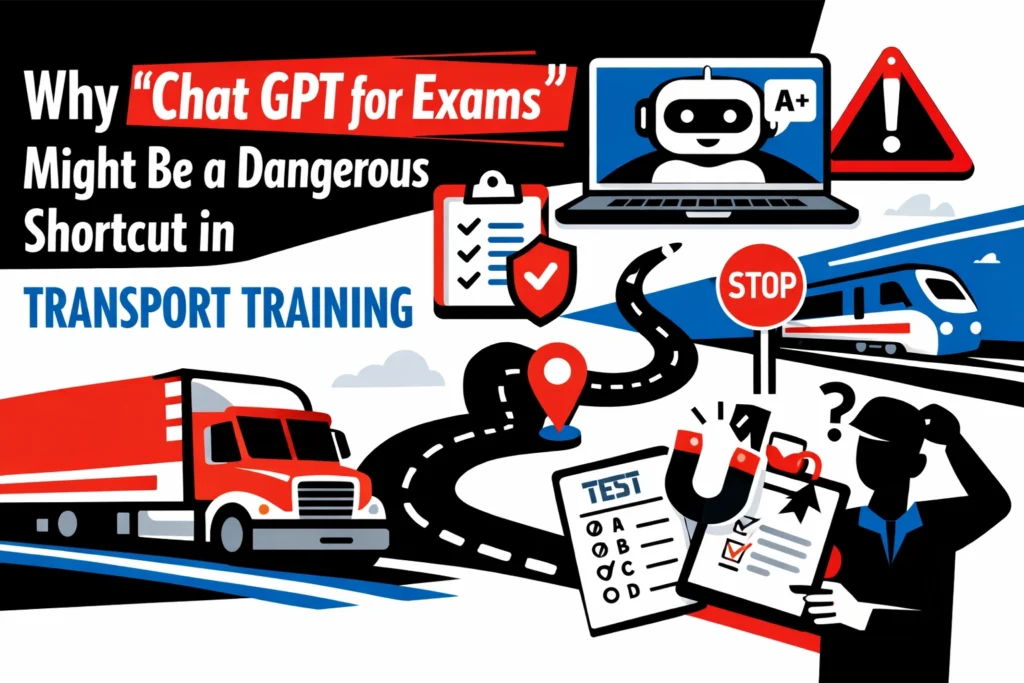
Have you ever found yourself staring at a pile of Transport Manager CPC manuals and thought, "There has to be a quicker way"?
It is a common feeling. Whether you are prepping for your ADR or trying to wrap your head around Operator Licence requirements, the volume of information is huge. This is where AI tools like ChatGPT come in. They are fast, they are free, and they seem to know everything.
But here is the truth: relying on Chat GPT for exams (or for “quick legal answers”) in the transport industry is a bit like driving a 44-tonne truck with a faulty steering rack. It might get you moving, but you probably won't end up where you intended to go.
This matters even more in the UK because road transport isn’t just “best practice” — it’s law. If you misinterpret the rules around drivers’ hours, tachographs, maintenance, loading, or dangerous goods, the consequences can be immediate and expensive. DVSA traffic examiners can issue roadside sanctions in line with the DVSA Enforcement Sanctions Policy (official guidance that sets out what action can be taken for different offences).
Before we dive in, let’s be honest. This very blog post was mostly generated by an AI. However, and this is the important part, it has been manually checked, edited, and verified by me, a real person with actual industry experience. If we hadn't checked it, you shouldn't trust it. That is the exact lesson we are talking about today.
1. The Surface Appeal of AI in Study
On the surface, using AI for your revision looks like a stroke of genius. It is 11:00 PM, you’re stuck on a question about tachograph exemptions, and you want an answer right now.
1.1 Why it feels like a good idea
- Instant Feedback: You type a question, and you get a response in seconds.
- Summarisation: It can take a long page of legislation and turn it into three bullet points.
- Availability: AI doesn't sleep. It’s there for you on a Sunday night when your instructor is at home.
1.2 The "Easy Way Out" Trap
It is tempting to think that "Chat GPT for exams" is the ultimate revision hack. Why spend weeks on a Transport Manager course in Scotland when a bot can give you the answers?
The problem is that learning isn't just about having the answer. It’s about understanding the "why" behind the answer. AI gives you the "what," but it often misses the "how" and the "is this actually current law?"

2. Why AI Often Gets the Answer Wrong (and why that becomes a legal problem)
This is where things get dangerous. AI models do not “know” facts. They predict the next likely word in a sentence based on patterns in the data they were trained on. This is called “hallucination”. In UK transport, a hallucination isn’t just embarrassing — it can turn into a roadside offence, a sanction, and a compliance black mark that follows your operation.
2.1 The Accuracy Problem in UK transport rules
A lot of transport compliance is detail-heavy: definitions, thresholds, exemptions, and “it depends” scenarios. AI is notorious for sounding confident while missing one key condition that changes everything.
Examples where AI commonly trips people up:
- Tachograph scope & exemptions (and mixing up GB vs EU/IR rules and edge cases)
- Drivers’ hours “rest” calculations (especially split daily rest and weekly rest compensation)
- Operator licensing undertakings (what you must do vs what’s “recommended”)
- Maintenance and inspection intervals (confusing internal policy with legal expectation)
2.2 Outdated information (and confident answers)
Laws and enforcement focus change over time. AI tools can give you answers based on old guidance or incomplete sources, then present it as if it’s current. If DVSA have updated their approach, the bot won’t tap you on the shoulder and say “double-check the policy document”.
2.3 UK offences and penalties: what DVSA can do at the roadside
If you use AI to “translate” legislation and you get it wrong, the consequences are real. DVSA traffic examiners and the police can take action during roadside checks in line with the DVSA Enforcement Sanctions Policy:
- Fixed penalties are commonly issued for certain offences and can be £50 to £300 depending on the offence.
- Prohibition notices (PG9) can stop the vehicle from being used until defects or issues are dealt with (that can ruin a day’s work very quickly).
- Escalation beyond the roadside can happen where the issues indicate a wider compliance failure — including action that can ultimately threaten an Operator’s Licence.
If you’re a Transport Manager, don’t shoot the messenger: “I asked AI and it said it was fine” won’t help if DVSA record the offence and it feeds into bigger operator compliance action.
3. The "Exam Day" Reality Check
Let’s talk about the day you sit down for your Road Haulage Transport Manager CPC course final exam.
3.1 You are on your own
When you walk into that exam room, your phone stays in your locker. Your laptop is away. There is no Chat GPT for exams to save you. At that moment, the only thing that matters is what is stored in your head.
3.2 The danger of "Fake Knowledge"
If you have used AI to check your Transport Manager mock exam, you might feel confident because the AI told you that you were right. But what if the AI was wrong? You will go into the exam believing a lie.
You won't just fail the exam; you will fail it because you "knew" the wrong information. That is much harder to fix than simply not knowing the answer at all.
4. Why AI Is a Risk to Your Career (UK law, offences, and real sanctions)
In the transport and logistics industry, compliance is everything. If you are a Transport Manager, your name is tied to the Operator Licence and you’re expected to run a compliant operation. If you’re a driver, you can be the person who gets stopped, checked, and sanctioned there and then. Either way, “I misunderstood the rule” is still an offence when it hits the roadside.
4.1 UK laws and enforcement: why “close enough” answers are dangerous
UK transport compliance sits across multiple legal areas (drivers’ hours and tachographs, roadworthiness, overloading, licensing, dangerous goods and more). DVSA and the police enforce these rules daily.
DVSA’s own approach is set out in the DVSA Enforcement Sanctions Policy:
DVSA traffic examiners use a range of sanctions at the roadside to deal with offences and non-compliance.
This means enforcement isn’t theoretical. If the vehicle, paperwork, or driver activity doesn’t meet the standard, action can follow immediately.
4.2 The real-world consequences you can face (not just “failing an exam”)
Misinterpreting UK rules via AI can lead to:
- Fixed penalties: typically £50–£300 depending on the offence.
- Prohibition notices (PG9): the vehicle can be prohibited from moving until defects/issues are put right (and some prohibitions can be classed as more serious where the defect is significant).
- Operator compliance action: repeated or serious issues can be escalated beyond the roadside, with the potential for regulatory consequences that can ultimately put an Operator’s Licence at risk.
4.3 Who gets hit hardest: transport managers and drivers
If you’re a Transport Manager, roadside findings can raise questions about:
- maintenance systems
- safety inspection frequency and quality
- defect reporting and rectification
- driver management (hours, tachographs, training, procedures)
If you’re a driver, you can face penalties on the spot, delays, and enforcement action for non-compliance linked to your driving, records, or vehicle condition.
Bottom line: AI can be useful for learning. But using it as a “legal interpreter” can land you with the wrong answer at the worst possible time.
5. How DVSA identifies offences at roadside checks (and why AI guesses can backfire)
What actually happens when DVSA stop a vehicle? This is where “I thought the rule was…” turns into “here’s the sanction”.
5.1 What DVSA will look at during a stop
Roadside checks can involve (depending on the vehicle and what triggers the stop):
- Driver documentation and entitlement (licence, CPC where relevant, tachograph card use)
- Tachograph records / drivers’ hours compliance (downloads, infringements, missing records, manipulation indicators)
- Vehicle roadworthiness (lights, tyres, brakes, steering, suspension, load security and general condition)
- Weights and loading (overloading, axle weights, load security)
- Operator compliance indicators (patterns of defects, repeat non-compliance, poor systems)
DVSA don’t need you to “agree” with the law to enforce it. They check what’s in front of them, compare it to the rules, and apply sanctions using the DVSA Enforcement Sanctions Policy.
5.2 Severity: from “sorted at the roadside” to “this is going further”
Sanctions can ramp up quickly based on risk and seriousness:
- A fixed penalty (£50–£300) might apply for some offences.
- A PG9 prohibition can take the vehicle off the road until it’s safe/legal to proceed.
- Where findings suggest wider failures, matters can be escalated, and the impact can be serious for both the driver and the transport manager/operator — including consequences that can ultimately threaten an Operator’s Licence.
5.3 Where proper training beats AI every time
AI can summarise. It can’t reliably judge how enforcement is applied in the real world. Good training gives you:
- the correct rule
- the typical enforcement outcomes
- the practical “how to stay compliant” steps that prevent a stop becoming a sanction
At Open Road Training Ltd, we use tech where it helps, but we don’t pretend a chatbot can replace professional training and current, UK-specific compliance knowledge.
6. Summary: How to Use AI Safely
If you are going to use AI, you need to use it as a secondary tool, not a primary source.
- Never use it for legal advice. Always consult official government sources or a qualified instructor.
- Verify everything. If an AI gives you an answer for a mock test, check it against your Transport Manager course materials.
- Focus on the "Why". If you don't understand the logic behind a rule, ask a human.
- Practice for the real environment. Use your revision time to get used to the conditions of the actual exam.
7. Conclusion: We Love AI, But We Value Your Career More
AI is an incredible tool. It helps us write, code, and organise our lives. But it is not a solution for high-stakes training and development.
In the transport industry, there is simply too much at risk. A wrong answer isn't just a red mark on a test paper; it's a potential safety hazard, a legal nightmare, and a threat to your livelihood.
Don't settle for a "Chat GPT for exams" shortcut. If you want to succeed, you need honest, professional training from people who know the industry inside out.
Ready to get started the right way? Check out our upcoming course dates or take a look at our free introductory transport manager course to see the difference that real expertise makes.
Don't leave your career to chance (or to a bot). Train with the pros.