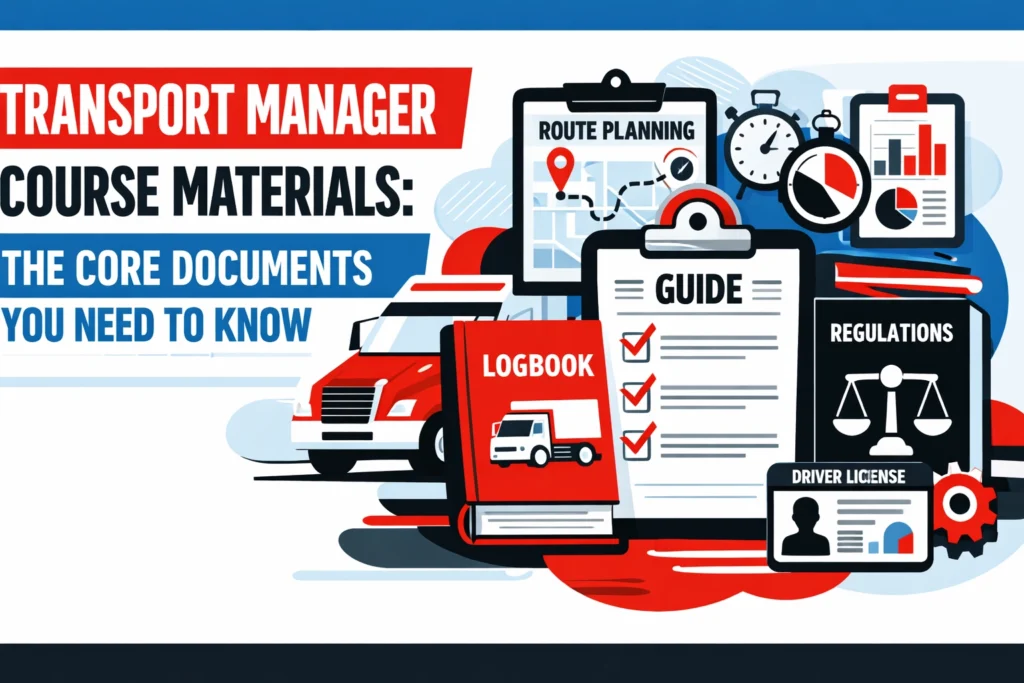
If you’re reading this, you’re likely thinking about stepping up and taking your Transport Manager Certificate of Professional Competence (CPC). Whether you are aiming for the Road Haulage (LGV) or the Passenger Transport (PCV) qualification, one thing is certain: there is a lot of reading involved.
The books we provide for the course are an abbreviated version of the documents you can download for free; I make no secret of that. The books we offer do make the whole course digestible, though. If you wish to read through where the information comes from, we are offering links to download the Transport Manager CPC Study material for free.
In this guide, I’m going to break down the core documents you need to master to pass your course and keep your O-licence safe.
0. The Core CPC Documents (Grouped): Your Foundation for Both Haulage and Passenger Exams here you can find your Transport Manager Course Materials Free
What are the “must-know” sources the CPC exam is built on?
These are the foundations of both the Road Haulage (LGV) and Passenger Transport (PCV) Transport Manager CPC exams. You’ll see these laws and guides referenced again and again in multiple-choice questions and in the case study.
Everything below links to an official .gov.uk or legislation.gov.uk source (so you’re reading the real thing, not a “summary” someone’s posted online).
0.1 Licensing & Management (Operator licensing + the Transport Manager role)
These are the documents that explain who can operate, under what licence, and what the Traffic Commissioner expects from you as a TM.
- Regulation (EC) No 1071/2009 (Common rules for road transport operators)
What it covers: “good repute”, financial standing, professional competence (the pillars behind operator licensing and the TM role).
Link: https://www.legislation.gov.uk/eur/2009/1071 - Goods Vehicles (Licensing of Operators) Act 1995
What it covers: Great Britain’s legal framework for goods operator licensing, undertakings, offences, and enforcement powers.
Link: https://www.legislation.gov.uk/ukpga/1995/23/contents - Statutory Document 3 (Transport Managers)
What it covers: “Continuous and Effective Responsibility” (what you must do in practice), plus how the Traffic Commissioner measures TM performance.
Link: https://www.gov.uk/government/publications/senior-traffic-commissioner-statutory-document-3-transport-managers - Public Passenger Vehicles Act 1981
What it covers: The legal framework around PSVs, operator licensing concepts in passenger transport, and key definitions.
Link: https://www.legislation.gov.uk/ukpga/1981/14 - Transport Act 1985
What it covers: Public passenger transport governance and the broader legal background that often pops up in the PCV syllabus.
Link: https://www.legislation.gov.uk/ukpga/1985/67
0.2 Vehicle Standards & Weights (roadworthiness, inspection systems, and staying legal at the roadside)
This is where the exam tests whether you understand preventative maintenance and how to keep vehicles within legal limits.
- DVSA Guide to Maintaining Roadworthiness
What it covers: inspection intervals, daily checks, defect reporting, records, and maintenance systems for both HGV and PSV operations.
Link: https://www.gov.uk/government/publications/guide-to-maintaining-roadworthiness - Weight and Dimension Regulations (HGV maximum weights leaflet)
What it covers: axle weights, gross weights, and core rules on loading limits (a frequent case-study topic).
Link: https://www.gov.uk/government/publications/hgv-maximum-weights-leaflet
0.3 Driver Rules & Records (drivers’ hours, WTD, tachographs, and entitlement checks)
This is the area that usually decides whether your schedules and record-keeping stand up to scrutiny (in the exam and at the roadside).
- Drivers’ Hours Rules (GV262 Goods)
What it covers: drivers’ hours, breaks, rest, and tachograph rules for goods vehicles in GB.
Link: https://www.gov.uk/government/publications/rules-on-drivers-hours-and-tachographs-goods-vehicles-in-gb - Drivers’ Hours Rules (PSV375 Passenger)
What it covers: drivers’ hours, breaks, rest, and tachograph rules for passenger-carrying vehicles in GB.
Link: https://www.gov.uk/government/publications/rules-on-drivers-hours-and-tachographs-passenger-carrying-vehicles-in-gb - Working Time Directive (Road Transport Regulations 2005)
What it covers: working time limits, breaks, reference periods, and record-keeping for mobile workers (this is exam territory, whether you like it or not).
Link: https://www.legislation.gov.uk/uksi/2005/639/contents/made - Tachograph Records & Data Management (GOV.UK guidance)
What it covers: tachograph use basics and how records fit together (driver cards, vehicle units, downloads, and expectations).
Link: https://www.gov.uk/guidance/drivers-hours-goods-vehicles/4-tachographs - Driver Licence Entitlements (View driving record)
What it covers: checking entitlement and status (useful when you’re verifying new starters or agency drivers).
Link: https://www.gov.uk/view-driving-record
0.4 Law & Compliance (enforcement, H&S duties, and “business law” topics that get tested)
These are the documents that explain your duty of care, how enforcement works, and the basic legal/fiscal principles the CPC expects you to understand.
- Health and Safety at Work etc. Act 1974
What it covers: employer and employee duties, safe systems of work, and the legal backbone behind workplace transport safety.
Link: https://www.legislation.gov.uk/ukpga/1974/37/contents - DVSA Enforcement Sanctions Policy
What it covers: how DVSA applies sanctions and the consequences of non-compliance (prohibitions, penalties, and escalation).
Link: https://www.gov.uk/government/publications/enforcement-sanctions-policy - Business Law & Fiscal Law (CPC syllabus topics)
What it covers: general principles of contracts, plus core fiscal awareness such as VAT, VED, and corporate tax, as tested in the CPC. (There isn’t one single CPC “business law” booklet on GOV.UK, so treat this as a study area rather than one document.)
0.5 International Transport (cross-border carriage and movement of goods)
Even if most of your work is UK-based, the CPC still expects you to understand key international principles.
- CMR (Carriage of Goods by Road Act 1965)
What it covers: the legal basis for international carriage of goods by road, liability, and consignment note principles.
Link: https://www.legislation.gov.uk/ukpga/1965/37 - ATA Carnets & International Permits (GOV.UK guidance)
What it covers: carnets (temporary export/import documents) and the basics of moving goods internationally.
Link: https://www.gov.uk/guidance/get-an-ata-carnet
1. Statutory Document 3: Transport Managers
If there is a “Bible” for this industry, this is it. Issued by the Senior Traffic Commissioner, Statutory Document 3 outlines exactly what is expected of a Transport Manager.
1.1 What is it?
This document explains the concept of “Continuous and Effective Responsibility.” It’s the rulebook that defines whether you are doing your job correctly in the eyes of the law.
1.2 Why do you need it for the course?
The exam often asks questions about the requirements for being a “reputed” Transport Manager. This document covers:
- How many hours a TM should work based on fleet size?
- The distance a TM can live from the operating centre.
- What happens during a Public Inquiry if things go wrong?
This means: If you don’t understand Stat Doc 3, you don’t understand the legal foundation of your future job.
Download link: Statutory Document 3 (Transport Managers)

2. The Guide to Maintaining Roadworthiness
You might be great at the business side of things, but a huge part of the Transport Manager course is technical. You need to know how to keep your fleet in top shape.
2.1 What is it?
This guide is the industry standard for vehicle maintenance. It covers everything from daily walk-around checks to the frequency of safety inspections. It applies to both heavy goods vehicles and public service vehicles.
2.2 Key topics for the exam:
- Daily checks: What must a driver look for before leaving the yard?
- Safety Inspections: How often should they happen? (Spoiler: it depends on the age and use of the vehicle).
- Record keeping: How long must you keep maintenance records? (The answer is 15 months, and they will definitely ask you this!)
This means: You aren’t just learning how to fix a truck or bus; you’re learning how to manage the system that ensures they never break down in a way that endangers the public.
Download link: Guide to Maintaining Roadworthiness
3. Drivers’ Hours and Tachograph Rules
This is usually the section that makes students sweat. The rules around how long a driver can sit behind the wheel are complex, but they are the “bread and butter” of the Transport Manager course.
3.1 Road Haulage (GV262)
For those taking the Goods route, the GV262 is your primary reference. It covers EU rules, GB domestic rules, and the Working Time Directive.
3.2 Passenger Transport (PSV375)
If you’re on the Passenger course, the rules change slightly, especially regarding breaks and “split” daily rest periods. The PSV375 is your go-to guide.
3.3 Why it matters:
The “Case Study” part of your exam will almost certainly require you to build a driver schedule. If you get the rest periods wrong by even 15 minutes, you could fail that entire question. We spend a lot of time on this during our training sessions in Glasgow and Edinburgh because it’s where most people slip up.
Download links:

4. DVSA Enforcement Sanctions Policy
Have you ever wondered what actually happens if a driver is caught over their hours or if a vehicle is overloaded? The DVSA doesn’t just make it up on the spot; they follow a strict policy.
4.1 What does this document cover?
The Sanctions Policy lists every possible offence and the corresponding “points” or fines. It covers:
- Fixed penalty notices.
- Graduated fixed penalties.
- When a vehicle will be “prohibited” (taken off the road immediately).
4.2 Practical application:
In the exam, you might be asked to justify why a certain action should be taken after a driver commits an offence. Knowing the severity of different infringements and how they affect your Operator Compliance Risk Score (OCRS) is vital.
This means: This document helps you understand the “teeth” of the DVSA. It’s not just about knowing the rules; it’s about knowing the consequences of breaking them.
To get your Transport Manager Course materials free, follow the Download link: DVSA Enforcement Sanctions Policy
5. Goods Vehicle Operator Licensing Guide (GV74)
Before you can be a Transport Manager, the company needs an Operator’s Licence. The GV74 (for Haulage) is the manual for that process.
5.1 What is it?
This guide explains the different types of licences (Standard National, Standard International, and Restricted) and the requirements for each.
5.2 Why is it in the course?
You need to know the “Financial Standing” requirements: essentially, how much money the business needs in the bank to prove it can maintain its fleet. These figures change almost every year, so using the latest GOV.UK link is the only way to stay current.
This means: You’ll learn the difference between an “operating centre” and a “registered office,” and how to apply for a licence without getting rejected by the Traffic Commissioner.
To get your Transport Manager Course materials free, follow the link: Goods Vehicle Operator Licensing Guide (GV74)

6. How to Use These Materials in Your Exam
It’s important to remember that the Transport Manager CPC exam is usually “open book” for the case study element. This doesn’t mean you can just walk in and look up every answer: you won’t have enough time.
6.1 Indexing is key
When we run our courses across Lanarkshire, we teach our students how to index these documents. You should have tabs for “Maintenance,” “Daily Rest,” “Financial Standing,” and “Prohibitions.”
6.2 Don’t rely on old versions
The law changes. If you are using a PDF you found on a forum from 2019, you will get questions wrong. Always go directly to the GOV.UK, I’ve provided the UK links above to ensure you have the 2026 versions.

7. Summary: Why We Point You to the Source
At Open Road Training Ltd, we could sell you the course book for £140 for “exclusive course materials.” But we want to give you the choice. You can download the comprehensive list of documents that’s not limited to what’s shown on this page, or you can buy the study materials that cover the main key points and have qualified thousands of transport managers over the years. But if you want a head start before your course, then this is a great place to start.
We want you to become a competent Transport Manager. Part of that competence is knowing where to find the law when you’re back in the office, and a driver asks you a difficult question. By using the official government documents during your training, you are building the habits of a professional.
7.1 Need a hand getting through it? get your Transport Manager Course Materials Free
Reading these documents is one thing; understanding how they interact is another. If you’re looking for a casual but professional environment to get your CPC, we’re here to help. Whether you are in Glasgow, Edinburgh, or anywhere in between, our instructors (who are active TMs!) can help make sense of the jargon.
Ready to get started?
Check out our upcoming Transport Manager Course Dates and secure your spot. We cover both Road Haulage and Passenger Transport, ensuring you get the specific training you need for your career path.

Don’t let the paperwork intimidate you. Once you break it down into these core documents, the path to becoming a qualified Transport Manager becomes a lot clearer. See you on the road!
Download your Transport Manager Course Materials Free! Or if you want the books, app, or eLearning suite, visit our store.