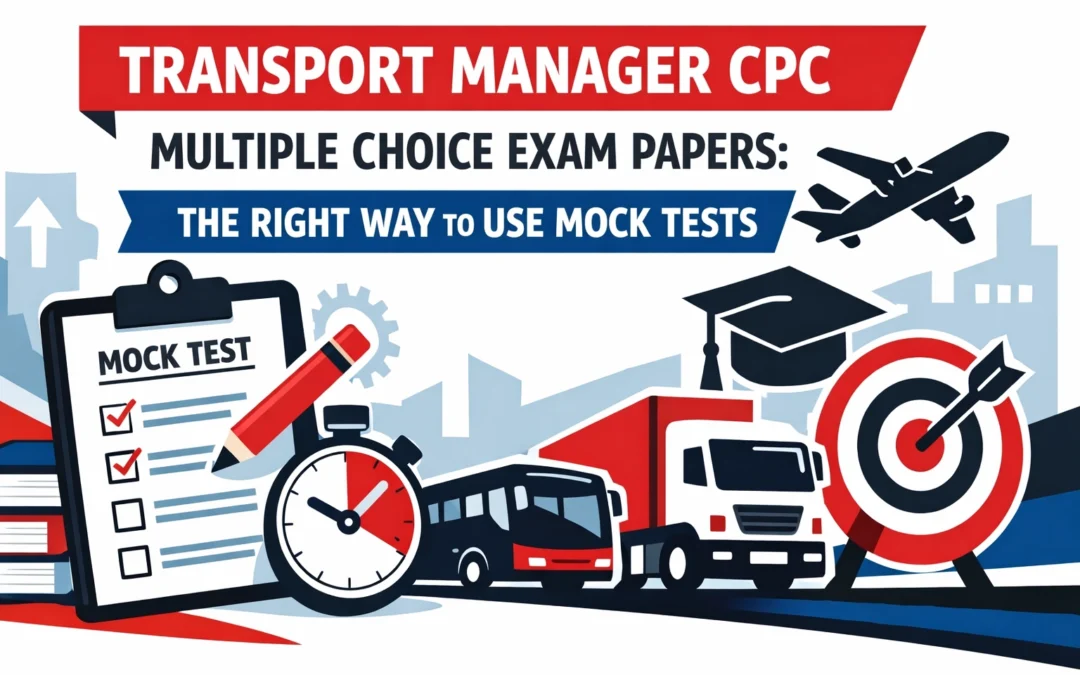
If you are preparing for your Transport Manager Certificate of Professional Competence (CPC), you already know how daunting the syllabus can be. From financial management and civil law to technical standards and road safety, the volume of information is significant. Naturally, many candidates go hunting for Transport Manager CPC Multiple Choice Exam Papers as soon as they start their revision.
While practicing with past papers is a vital part of your preparation, there is a right way and a wrong way to use them. Many students fall into the trap of using mock tests as their primary learning tool. This is a mistake that frequently leads to failure on exam day.
In this guide, we will break down why you should stop using mock tests to “learn” and start using them to “confirm.”
1.0 The True Purpose of Mock Tests
It is a common misconception that if you do enough practice questions, you will eventually encounter everything that could be on the real exam. This “brute force” method of learning is ineffective for a professional qualification like the Transport Manager CPC. This is what is known as ROTE learning and is not suitable to retain the information on a transport manager exam.
1.1 Confirmation, Not Education
The primary role of mock tests is to confirm the knowledge you have already acquired. Think of a mock exam as a barometer. It tells you the “weather” of your current understanding: it doesn’t change the weather.
If you sit down to a set of Transport Manager CPC Multiple Choice Exam Papers before you have thoroughly read your training manuals, you aren’t testing your knowledge; you are testing your ability to guess.
1.2 Identifying Gaps
The only time a mock test should influence your learning is by highlighting your weaknesses. If you consistently score low in “Financial Management” but high in “Technical Standards,” the mock test has done its job. It has told you exactly which chapter of your book you need to go back and reread.
2.0 The Danger of the “Lucky Guess”
We have all been there. You look at a multiple-choice question, you aren’t 100% sure, so you pick “B” because it looks the most official. You check the answer key, and you got it right. You feel a surge of confidence and move on to the next question.
2.1 Why Luck is Your Enemy
In the context of the Transport Manager CPC, a lucky guess is more dangerous than a wrong answer. Why? Because if you get an answer wrong, you know you don’t understand the topic. You are forced to look it up.
If you guess correctly, you falsely assume you have mastered that piece of legislation. However, the examiners are experts at rephrasing questions. On the actual exam day, they might ask the same concept from a different angle. If you don’t understand the “why” behind the answer, that lucky “B” won’t save you next time.
2.2 You Won’t Know What You Don’t Know
When you guess, you lose the ability to track your progress accurately. To pass the multiple-choice paper, you need a 70% score (42 out of 60 questions).
3.0 Stop Using Google and ChatGPT for Quick Answers
We live in the age of instant information. If you hit a question you don’t know, the temptation to type it into Google or ask ChatGPT is massive. Some students even use dedicated apps to find quick answers.
This is a shortcut to failure.
3.1 The “How” and “Why” vs. The “What”
Search engines and AI models provide you with the “What”: the final answer. But the Transport Manager CPC exam isn’t just about the final answer; it’s about the process.
For example, if a question asks about a driver’s rest requirements, an AI might give you the number of hours. But by searching for the answer that way, you miss out on the context:
- How does this rest period interact with the working time directive?
- What are the specific derogations?
- How do you record this on a digital tachograph?
3.2 Memory Retention
The human brain is programmed to forget information that is too easy to find. This is known as “digital amnesia.” If you find an answer in two seconds via an app, your brain doesn’t bother storing it because it knows it can just “search” again. When you are in the exam room with no internet access, that “search” button in your brain will come up empty.

4.0 The “Look It Up” Method: Using Your Training Books
When you encounter a question in your Transport Manager CPC Multiple Choice Exam Papers that you cannot answer confidently, there is only one place you should go: your training manual.
4.1 Navigating the Manual
Whether you are using our Transport Manager CPC Home Study materials or attending classroom training, your books are your greatest asset.
By physically (or digitally) flipping through the pages to find an answer, you are engaging in “Active Recall.” You see the headings, you see the surrounding paragraphs, and you see the diagrams. This context reinforces the information.
4.2 Building a Mental Map
As you reread the section to find the answer, you are building a mental map of the syllabus. You start to remember that “Operator Licensing” is at the start of the book, while “International Transport” is toward the end. This organizational knowledge helps reduce anxiety during the exam because the information feels structured in your mind.
5.0 Rereading is the Secret to Retention
It isn’t glamorous, and it isn’t “fun,” but rereading your training books is the single most effective way to ensure you pass.
5.1 The Layering Effect
The first time you read the manual, you are just trying to understand the words. The second time, you start to see how the different laws connect. By the third time, you are identifying the subtle details that the examiners use to trip people up.
5.2 Strengthening the “Why”
The multiple-choice paper often includes “distractors”: answers that look correct but are technically wrong due to a single word (like “must” vs “should”). You will only spot these distractors if you have spent enough time with the source material to understand the legislative intent.
6.0 Understanding the Exam Structure
To use Transport Manager CPC Multiple Choice Exam Papers effectively, you need to know exactly what you are up against. Based on current standards
- Format: 60 Multiple Choice Questions.
- Duration: 120 minutes (2 hours).
- Pass Mark: 70% (42 correct answers).
- Style: Closed book. You cannot take any notes or books into this specific part of the exam.
Because it is a closed-book exam, your reliance on “memory through understanding” is paramount. You cannot rely on being “good at searching”; you have to know the content.

7.0 A Step-by-Step Strategy for Study
So, how should you integrate mock papers into your schedule? We recommend the following approach:
- Read the Module: Read a full chapter of your training manual.
- Take Notes: Summarize the key points in your own words.
- The Mini-Test: Do 5-10 questions specifically on that chapter.
- The “Why” Check: For every question you get right, ask yourself: “Can I explain why this is the answer to someone else?” If not, reread the section.
- The Full Mock: Only attempt a full 60-question Transport Manager CPC Multiple Choice Exam Paper after you have finished the entire book.
- The Review: Spend twice as much time reviewing the mock test as you did taking it. Go back to the book for every single incorrect answer: and every lucky guess.
If you feel you need more structure, consider our Intro to Transport Manager Course (Free) to get a feel for the level of detail required.
8.0 Summary: How to Ensure a Pass
Passing the Transport Manager CPC is a significant career milestone. It opens doors to higher salaries and management positions within the logistics industry. Don’t gamble that opportunity on a strategy built on guessing and Google searches.
- Mock tests confirm knowledge; they don’t create it.
- A lucky guess is a missed opportunity to learn.
- Your training manual is your primary source of truth.
- Rereading creates the deep retention needed for a closed-book exam.
At Open Road Training Ltd, we provide the tools you need to succeed, whether you prefer Road Haulage or Passenger Transport.
Ready to get started? Check our upcoming Course Dates to find a classroom session near you, or visit our Shop to pick up your home study materials today. Remember: the goal isn’t just to pass the exam; it’s to become a competent, knowledgeable Transport Manager who can keep a fleet ,safe and compliant.